The OLED-Info weekly newsletter
Published: Tue, 10/12/21



The OLED-Info newsletter (October 12, 2021)
Cannot read this? View it online here
DSCC sees the OLED market reaching $60 billion in 2026, fueled by increased laptop, monitor and tablet display shipments
DSCC released its later OLED market forecasts, which now includes 2026. DSCC sees the rate of OLED market growth decelerating, with revenues reaching just over $60 billion in 2026.
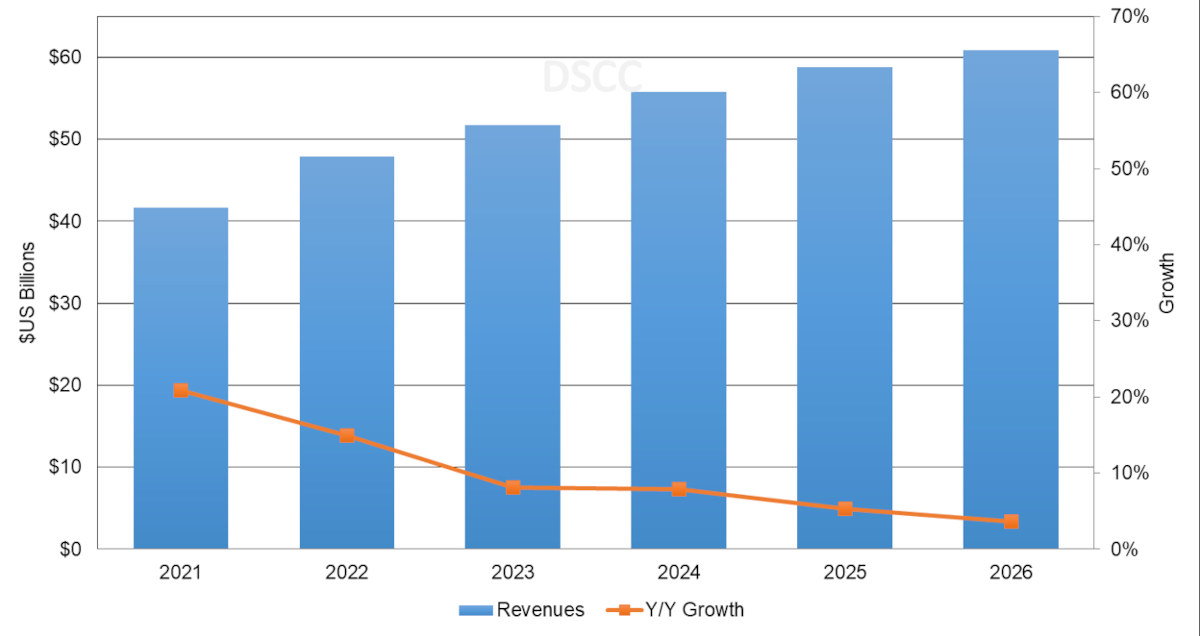
Most of the growth in the next 5 yeas, according to DSCC, will come from new IT applications: OLED displays for monitors, laptops and tablets.
LGD's OLED TV panels recognized as the world's best gaming TV panels
LG Display announced that its OLED TV displays has received two global gaming certifications. First up is a "Qualified Superior Gaming Performance" certification from British certification company Intertek, and the second is the "High Gaming Performance Gold certification" from German inspection service TÜV Rheinland. LG Display says it is the first display company to receive these two certificates together.

According to Intertek’s test results, the LG's OLED TV panels are the fastest display available today with a fast response time of less than 0.1 ms (0.0001 seconds) based on GTG (Gray to Gray) measurement method. In addition, OLED is found to be inverse ghosting free – an issue commonly seen on LCD displays where previous image frames linger because they are simply too fast for the LCD displays to handle.
The worldwide component shortage is affecting the OLED industry
In recent months, the world is suffering from a serious semiconductor component shortage, due to several reasons that all seemed to have join forces - increased demand for IT products due to the pandemic, extreme weather conditions in the US and Asia, the US-China trade war, employee shortages, and the power grid problems that China is facing.

This semiconductor supply and demand crisis is affecting the global OLED industry. Some display makers cannot ship their displays - not because of OLED production problems, but because they cannot get enough driver ICs.
We have talked to several AMOLED and PMOLED producers and suppliers, to try and estimate the problems. The supply of ICs at some OLED makers is very tight, and they cannot meet their demand. Current lead times for some OLED displays can range from 26 weeks to over 52 weeks. This means you will have to wait over a year to get the panels you ordered!
The situation is not the same at all producers, as much depends on the choice of drive IC (or rather, the IC production partner). One PMOLED producer told us that they were prepared for such a situation, and have ordered a large number of ICs in advance, and so it can supply the demand for its PMOLEDs with almost no issues.
Some companies estimate things will only get better towards the end of next year, although some also experience a lower demand for its displays (due to the component shortage) and so its production capacity is catching up with its existing demand.
One segment of the market that is almost not affected is microdisplays . These OLED displays actually have their own driver ICs on the silicon wafer, so there is no need for external semiconductor chips. The silicon wafer market is facing its own problems, though - production is slowing in China (due to the electrical grid situation, mostly) and demand is not keeping up with supply. This does cause some delays in manufacturing at some OLED microdisplay makers, but the situation does not seem to be as problematic as it is in the AMOLED and PMOLED markets.

The main suggestion we can offer to display customers is to plan ahead. The situation is likely to continue, especially for small customers, well into 2022 and maybe into 2023 as well, and so projects will take much longer than before. You can get ready by ordering larger orders and has internal display inventory ready, and also make sure the display part of your project gets handled at a top priority.
If you need any assistance with finding the right OLED panel to your project, we'll be happy to help!
A macro photo of the Nintendo Switch OLED shows it is not a Pentile display
A few days ago Nintendo started shipping its anticipated Switch OLED gaming console, with its 7-inch 1280x720 OLED display. The console costs $349.99, and initial reviews find the display to be an excellent improvement over the LCD used in the previous model.

This is an interesting sub-pixel structure, quite similar to the one used by the Apple Watch - and it is not Samsung's standard architecture for mobile devices, the Pentile display (or Diamond Pixel structure). This could mean that SDC is not the producer of Nintendo's display, but rather LG Display, who makes most of the displays for Apple's Watch.
The MicroLED Transfer Process Market Report
MicroLED-Info is proud to announce a new market report, focused on the MicroLED Transfer Process. This market report provides a comprehensive look at the transfer (pick-and-place) process used to produce microLED panels.
Reading this report, you'll learn all about:
- All known microLED transfer processes
- The current industry and market status
- Advantages and disadvantages of transfer technologies
- Future technologies and roadmaps