The OLED-Info weekly newsletter
Published: Tue, 08/17/21



The OLED-Info newsletter (August 17, 2021)
Cannot read this? View it online here
New OLED gadget: Xiaomi Mi TV 6 OLED
Xiaomi's Mi TV 6 OLED features 55" or 65" 4K WOLED panels, 10-bit professional color depth, 900 nits peak brightness, HDR10+ and HLG.

The Mi TV 6 OLED will start shipping in China by the end of August 2021 starting at 5,699 Yuan (around $880).
New OLED gadget: Xiaomi Mi TV Master 77 OLED
Xiaomi's Mi TV Master 77 features a 77-inch 4K WOLED panel, high color gamut, 1000 nits peak brightness, 120Hz refresh rate, NVIDIA G-SYNC, VRR, ALLM and dual HDMI v2.1.

The Mi TV Master 77 will start shipping in China soon for 19,999 Yuan (around $3,000 USD).
Samsung considers building a 8.5-Gen AMOLED fab for IT displays
In the last couple of years, we have seen increased adoption of AMOLED displays in laptops. Earlier this year Samsung stated that it will release 10 new OLED displays for laptops in 2021, and reports suggested that the company is looking into building a dedicated 6-Gen production line for laptop AMOLEDs.

According to a new report from Korea, Samsung is considering building a 8.5-Gen (2200x2500 mm) production line for IT AMOLED displays. This will be the first time such a fab is used to create OLED displays. LG Display has 8.5-Gen lines, but these are used to deposit WOLED panels, and not side-by-side RGB OLEDs.
Samsung announces the Galaxy Fold3 and Flip3 foldable phones, and new smartwatches
Samsung announced several new OLED devices, including its two new foldable smartphones. First up is the Galaxy Z Fold3, which features a 7.6-inch 1768x2208 120Hz 1200 nits foldable Dynamic AMOLED X2 display, and a 6.2-inch 120Hz 832x2268 external AMOLED display. The foldable phone sports Samsung's first under-the-display selfie camera.

Samsung says that the new Galaxy Fold has an improved hinge design and is more durable compared to previous generation devices. The second phone is the Galaxy Flip3, which features a 6.7-inch 120Hz 1200 nits 1080x2640 foldable Dynamic AMOLED display, and an external 1.9" 260x512 Super AMOLED display.
Ergis extends its OLED encapsulation film platform to QD films
Last year, Poland-based Ergis Group launched an OLED encapsulation film platform called Ergis noDiffusion®. The company is currently testing its film solutions at customer sites in Asia, the EU and the US, and it is now starting to expand the platform for the protection of quantum dot films (QD films) used in display and lighting applications.

These new films can be tuned to fit specific needs. Ergis can deploy its films on several substrate types, with varying film thickness, and the barrier properties can be tuned to be between 10-6 to 10-3. This means that custom films can be created to suit the specific sensitivity of the QDs for water vapor and to achieve specific product lifetime or other required properties.
Philoptics launches a new project to develop innovative FMM masks built using Electro forming
Korea-based optical equipment maker Philoptics announced that it raised around $3.5 million that will be dedicated to the development of FMM technologies for OLED production. The company aims to raise a further $8.6 million by the end of the year to continue the development.
Philoptics will use the funds to finalize the development of 6-Gen FMM masks and build a pilot production line for these masks. Philoptics FMM production uses electro forming, where an invar is plated on a patterned substrate. The company says that using this method the FMM masks are thinner compared to other technologies which can increase the possible OLED resolutions under production.
New OLED gadget: Xiaomi Mix 4
The Xiaomi Mix 4 smartphone features a 6.67-inch 120Hz 800-nits 1080x2400 AMOLED display with an under-the-display camera, Qualcomm Snapdragon 888 chipset, 8/12 GB of RAM and 128/256/512GB of storage.

The Mix 4 should ship by the end of August 2021.
eMagin reports mixed 2Q 2021 financial results
OLED microdisplay maker eMagin reported mixed quarter results for Q2 2021. Production issues and unexpected manufacturing tool downtime reduced revenues, but the company says it increased shipments to military, medical and other customers. Revenues in the quarter were $6.3 million (down from $7.7 million in Q2 2020). Net loss in the quarter was $0.3 million (but this includes a $2.6 million non-cash profit due to change in value of a warrant liability).

eMagin says it continued to make steady progress on the direct-emission microdisplay project, and remains on schedule to produce full-color prototypes this year. eMagin also reports it is ramping up production of its latest XLE technology (which still uses color filters) and has closed a major design win with a military customers for XLE OLED microdisplays.
Mattrix Technologies demonstrates a 4.7" VOLET AMOLED built on an LCD a:Si backplane
Organic-TFT backplane/emitter developer Mattrix Technologies has demonstrated a new AMOLED display prototype that is based on an amorphous-silicon (a:Si) backplane.

Mattrix believes that its proprietary vertical, organic light-emitting transistor (VOLET) pixel technology can dramatically reduce OLED production costs and improve display quality.
Consumers are ready for an OLED laptop, at least according to our poll
In the last couple of years, we have seen OLED displays starting to be adopted in high-end laptop devices, and recently prices of OLED laptop panels have dropped and more mid-range laptops have opted for OLED displays (usually as an optional upgrade over an IPS LCD).
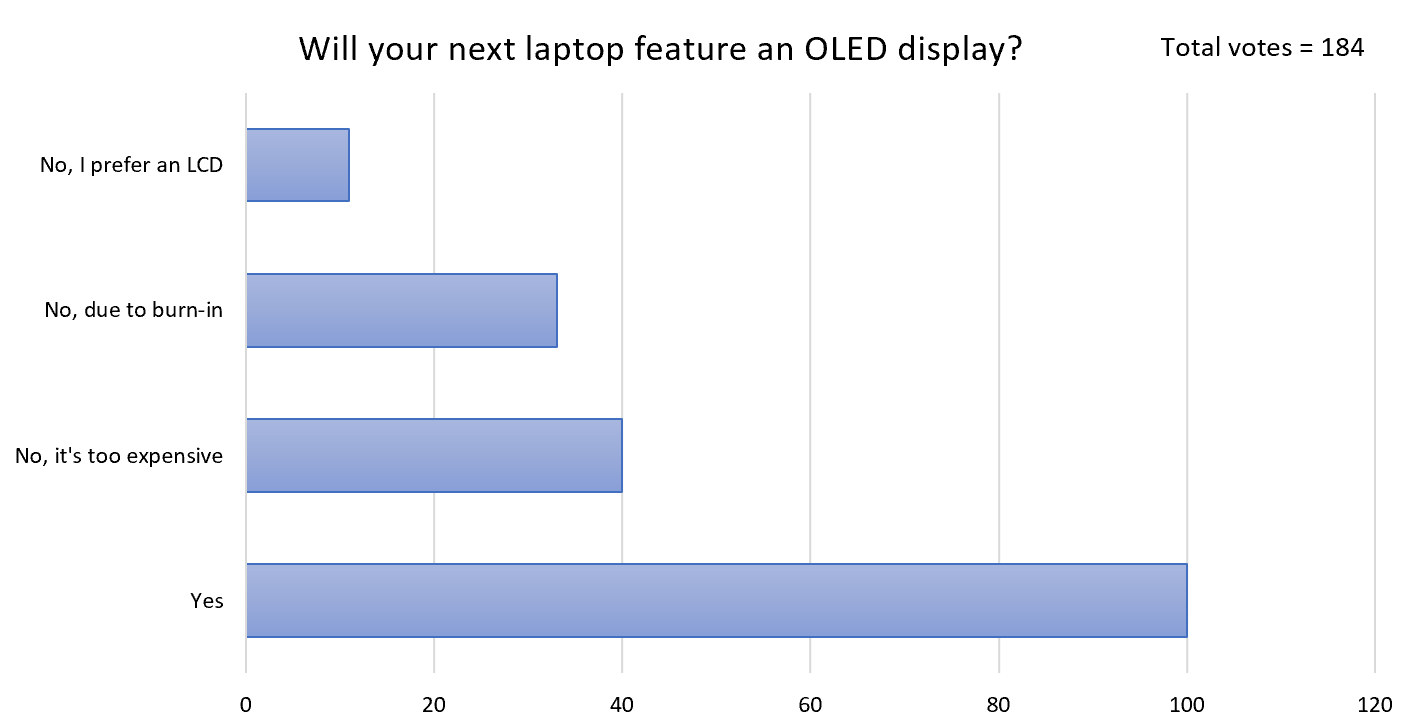
I recently bought a new laptop, the Lenovo Yoga Slim 7i Pro OLED, with a 14-inch 2880x1800 (2.8K) 90Hz AMOLED display. The screen, as expected from an OLED, looks brilliant. Some people are still concerned about OLED in laptops, though. Some worry that the display might suffer from burn-in.
OLETs used to create highly compact and cost-effective plasmonic optical sensor system
Researchers from Europe, working with funding from the EU research program at the MOLOKO project, developed a new plasmonic sensor system that integrates an organic light-emitting transistor (OLET), an organic photo-diode (OPD), and a nanostructured plasmonic grating (NPG) all in the same device.

The researchers say that this design enables to create cost-effective and highly miniaturized optical sensors based on the optics-less plasmonic system. The researchers further say that the potential of OLETs, as planar multielectrode devices with inherent micrometer-wide emission areas, offers the incorporation of the light-emitting and light-detection modules together at unprecedented lateral proximity.
New OLED gadget: ASUS ProArt StudioBook 16
The ASUS ProArt StudioBook 16 is a laptop aimed for creators, with a 16" 16;10 4K (3840x2400) 400-nits AMOLED display. Other features include a Ryzen 9 5900HX chipset, 16 GB of RAM, 2 TB of SSD storage an an NVIDIA GeForce RTX 3070 GPU.

The ProArt StudioBook 16 will cost around $3,000 when it ships later this year.
Samsung Display announces the polarizer-free ECo2OLED tech
Samsung Display announced its latest OLED panel, the Eco²OLED, which increase light output by 33% compared to SDC's previous OLED panels. The increase light translates into a power consumption reduction of up to 25%.

For the Eco²OLED panel, Samsung finally managed to commercialize a polarizer-free OLED, after many years of R&D. The first phone to adopt this display will be Samsung's upcoming Galaxy Fold 3. Interestingly Samsung says that the new design also enabled it to incorporate a high-quality under-the-display camera as more light is entered through the OLED.
LGD to increase pOLED production capacity in a $2.8 billion investment
A few weeks ago LG Display noted that it is reviewing a plan to expand the capacity of its mobile OLED production plants, and today LGD announced its formal plan to invest 3.3 trillion Won (around $2.8 billion) to expand pOLED capacity.
LGD will expand its 6-Gen AMOLED production capacity, and this expansion project will finish by March 2024. LGD did not provide any more details about this plan. LGD is enjoying high demand for its mobile AMOLED displays, with Apple one of its major customers.
DSCC: the AMOLED material market to grow to $1.4 billion in 2021, $2.18 billion in 2025
DSCC updated its AMOLED material market forecast, saying that the market will reach $1.4 billion in 2021 (up 32% from 2020), and grow at a 16% CAGR from 2019 ($927 million) to 2025, to reach $2.18 billion by 2025.

DSCC takes a look into the material cost for LG Display's WOLED TV panels. LGD will likely manage to implement incremental improvements in material utilization and price, which will enable the company to almost halve the material cost of its TV panels- from $88.14 per sqm in 2019 to $47.19 per sqm by 2025.
TCL to start supplying smartphone OLED displays to Samsung Electronics
According to reports from China, TCL will start supplying smartphone AMOLED panels to Samsung Electronics. TCL is already supplying LCDs to Samsung (for both phones and TVs), but this is the first time it will supply OLEDs as well.

Samsung is looking to lower its smartphones production costs, and so it widens its OLED supply chain. Up until now, the company relied 100% on AMOLEDs produced by Samsung Display, but earlier this year it started to buy OLED panels from BOE.