The OLED-Info weekly newsletter
Published: Tue, 06/29/21


The US aims to block Wise Road Capital from acquiring Magnachip
Earlier this year OLED driver IC developer MagnaChip announced that it is being acquired by China-based Wise Road Capital, for $1.4 billion. A few days ago, the Committee on Foreign Investment in the United States (CFIUS) issued an interim order that blocks the deal.

This is just an interim order, but according to reports it is unlikely that the US and Korea will allow the deal to go through, at least in its preset form. The US is expanding its fight against Chinese companies acquiring technologies. Korea is also worried as MagnaChip's OLED drivers are seen to be strategic to the country's OLED industry.
Kopin developed a 35,000-nits green monochrome OLED microdisplay
Kopin® Corporation announced it has produced a new 1" SXGA (1280x1024) green OLED microdisplay, that offers 35,000 nits of brightness. Kopin says that this display is the world's brightest OLED developed to date.

The display, which is still in development, uses Kopin's duo-stack OLED structure and a unique patent-pending pixel structure and backplane architecture for super-high dynamic range operation (14 bits).
A new transparent electrode design improves OLED light output by up to 20%
Researchers from the University of Michigan developed a new electrode design for OLED devices, that can increase light output by up to 20% compared to current electrodes. The new electrode is compatible with current production processes.

The new design helps to minimize the waveguiding effect, which traps around 80% of the light produced by the OLED emitters. The researchers used a modal elimination approach, which involves optimizing the organic stack and the replacing the ITO anode with a thin film of silver deposited on a layer of copper. This kind of approach can be applied to other light emitting structures such as inorganic LEDs, perovskite LEDs, quantum dots and more.
DSCC: Smartphone OLED shipments rise sharply in 2021
DSCC says that smartphone OLED shipments have increased around 50% in Q1 2021 compared to last year, and the growth will continue - around 30% in Q2 2021 and over 40% in Q3.
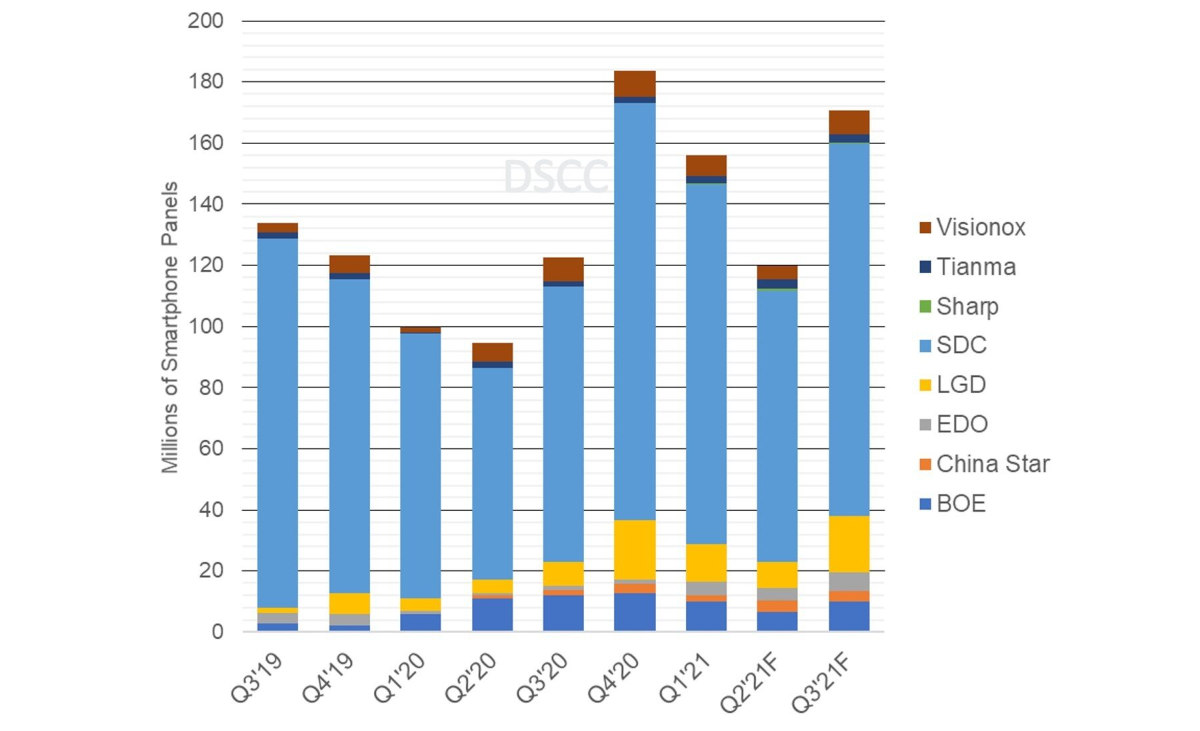
The market share of flexible AMOLEDs out of all OLEDs (rigid + flexible) continues to rise, and in Q1 2021 77% of all smartphone OLED displays were flexible ones. Samsung is still the largest producer by far, holding a 75% market share in Q1 2021. LG Display holds a 8% share and BOE 6%.
Omdia sees 8.3 million OLED TVs produced in 2021, a 86% increase from 2020
Omdia says that according to its estimates, LG Display will produce 8.3 million OLED TVs in 2021, a 86% increase from 2020 (4.5 million units). The company increased its estimates slightly (previously Omdia said that in 2021 LGD will produce 8.1 million panels).

LG Display's own target for 2021 is 8 million units. Demand for premium TVs is on the increase, and LG Display increased its production capacity, mostly at its Guangzhou line . LG Display's production of 48-inch and 42-inch panels may also decrease its average panel size which may increase total unit shipments.