The OLED-Info newsletter, July 2019
Published: Mon, 08/05/19


LG Display to start producing OLED TVs in its Guangzhou 8.5-Gen fab next month
In July 2017, LG Display announced its plans to build a 8.5-Gen (2200x2500) OLED TV production line in Guangzhou, China. Following many delays, LGD got the approval for its new OLED TV fab from both the Korean and Chinese governments in July 2018 and started constructing the fab, with an investment of about $4.2 billion.

Today LG Display announced that the Guangzhou fab will start production in August 2019. The fab will begin with test runs in July but it seems that LGD is confident that mass production will begin next month. The initial capacity of this new fab will be 60,000 monthly substrates, which will bring LGD's total OLED TV capacity to 130,000 monthly 8.5-Gen substrates (i.e. will almost double its current capacity).

The Guangzhou fab will eventually have 2 lines, with a total capacity of 90,000 monthly substrates. It is not clear when the second line will begin operation, though.

LGD hopes that the new Chinese fab will enable it to cut production costs due to lower wages and government subsidies. DSCC estimates that the subsidies will reduce LGD's depreciation costs by 65%. An unexpected bonus may be that this fab could enable LGD to circumvent Japan's recent export ban on Korea.




Will RiTDisplay and PlayNitride supply Apple with MicroLED displays?
Apple is currently using an LGD 1.57" 394x324 LTPO AMOLED display (1.78" 448x368 on the larger 44mm version) in its latest Watch smart wearable device. Apple's involvement in Micro-LED displays started in 2014 when it acquired LuxVue, and it was always assumed that Apple's main aim for the new display technology is to adopt it in wearable devices.
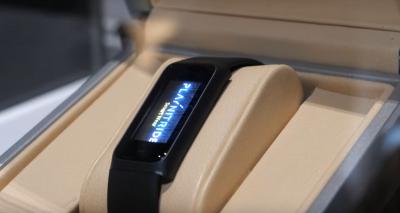
According to a new report from Taiwan, PlayNitride and RiTDisplay are in talks with Apple to supply microLED displays for Apple's next-generation Watch wearable. A micro-LED display could offer much higher brightness and efficiency compared to an AMOLED display, both of which could be highly desirable in wearable devices.
In May 2019 Taiwan-based PMOLED display maker RiT Display announced a strategic partnership and share swap with PlayNitride MicroLED developer. In June 2019 it was reported that a US-based smartwatch brand will start a design process in Q3 2019 using a 1.25" micro-LED display that was co-developed by RiTDisplay and PlayNitride. RiT will start shipping samples in Q4 2019.
If this report is true, Micro-LEDs could start disrupting the wearable display market sooner than expected, which could be quite bad news for LG Display (who shipped 16 million AMOLEDs for Apple's Watch in 2018) and perhaps Japan Display as well (who reportedly signed a supply agreement with Apple for the 2019 Watch display OLEDs, and could once again find itself on the wrong side of Apple's technology roadmap).
At SID DisplayWeek, PlayNitride demonstrated several new advanced, flexible and wearable Micro-LED displays. Click here for more information!
Samsung to launch the Galaxy Fold again in September
In April 2019, after early reviewers reported that that the foldable screen in their Galaxy Fold devices broke down after a day or so, Samsung decided to delay the release of its foldable smartphone, the Galaxy Fold.
Following three months of re-design, Samsung now announced that it fixed all the issues in its foldable smartphone and is ready to start shipping in September 2019. Click here to see Samsung's list of changes and improvements.
Japan restricts material exports to Korea
In early July 2019 Japan's government decided to restrict some material exports to South Korea. The restricted materials are fluorinated polyimide, resist - and high-purity hydrogen fluoride. Japan is the world's leader in production of these materials (about 90% of fluorinated polyimide and resist) which makes it difficult for producers to find alternatives.
According to a report from Korea, Samsung and other companies have warned the Korean government that production in some plants could be halted as early as by the end of July if these materials are not available. It is not clear what is the situation of Samsung's (and LG's) OLED production. It was suggested that LG Display will at least be able to go around these sanctions with its Guangzhou OLED TV fab in China - although production is only expected to begin now during the third quarter of 2019 and even so it will harm LGD's plans to increase production capacity in 2019 if its current OLED TV fabs will have to halt production. It is not clear whether these materials are actually used in OLED TV production (or only in flexible OLED production).
The Japanese government decided on these new restrictions following a decision in Korea that Japan's Nippon Steel must compensate Koreans for forced labor during World World Two - while Japan says that this issue was already settled in 1965.
OLED market updates
Here are the latest updates on the OLED market:
- DSCC: smartwatch OLED display shipments to grow 28% in 2019
- OLED-Info updates its OLED market reports
- AVC: OLED TV sales in China to reach 800,000 units in 2020, as China is set to become the world's largest market for OLED TVs
- DSCC sees the OLED material market growing from $1 billion in 2018 to over $2 billion in 2022
- Riber, Coherent and Cognex post clashing views on the 2020 OLED market rebound
CSoT demonstrated new OLED display prototypes and technologies at SID DisplayWeek 2019
China-based display maker CSoT demonstrated several new OLED display prototypes and technologies at SID 2019. First up is a 31" 4K (3840 x 2160, 144 PPI) AMOLED that was produced using an ink-jet printing process on an IGZO substrate. The peak brightness is 200 nits and the refresh rate is 120 Hz. This seems to be the same panel announced in March 2018 by Joshua Printing Display Technology (established by CSoT and Tianma in 2016). The display has some noticable defects.
Second up is a glass-free 3D (parallax barrier) transparent OLED. This panel is a 31" 1920x1080 (FHD) panel that features a 60Hz refresh rate and a brightness of 100 nits. The transparency is only 20%. The third OLED is a 6.6" 384x300 IGZO panel that uses perovskite quantum dots as a color conversion film (in this case to convert blue OLED materials to green color). CSoT terms this as PE-OLED, this is actually a QD-OLED display that uses perovskite quantum dots. Perovskites offer a simple synthesis combined with high luminescent efficiency and tunable wavelenghts, and this is certainly an interesting technology to watch. This is obviously a very early prototype.
Click here for more information and a video that shows CSoT's new display technology.
Researchers develop a single-layer, efficient TADF OLED device
Researchers from the Max Planck Institute for Polymer Research (MPI-P) have developed an efficient OLED device that is comprised of a single organic material layer - replacing the normal stack of 5-7 layers in modern OLED devices.

The researchers managed to create this OLED device by using a TADF material (CzDBA, diboron based TADF) and by using a newly developed charge injection strategy. The OLED device features a low operating voltage (2.9V at 10,000 cd/m2, an EQE of 19% (at 500 cd/m2) and a lifetime of 1,880 hours at 50% (for 1,000 cd/m2). The color of the device is greenish-yellow.
These are very impressive results - and a single layer OLED device could mean a much lower cost production process. The researchers are now aiming to improve the device further to extend the lifetime.
LG to invest a further $2.5 billion in its P10 OLED TV fab
LGD announced an additional investment of KRW 3 trillion ($2.5 billion) P10 10.5-Gen OLED TV fab in Paju. Last month it was reported that LG display has started to install some of the Oxide-TFT deposition equipment (supplied by Applied Materials and Jusung Engineering). The mass production at the first lines in the P10 fab is expected to begin in 2021. LG Display did not disclose any more details regarding this new $2.5 billion investment plan yet.
LG Displays is stepping up its efforts to "shift towards a more OLED-focused business structure" in the second half of 2019. LGD is optimistic regarding its OLED TV business as the Guangzhou OLED fab is starting production, which will almost double its OLED production capacity. In addition, the company hopes that it will start production in a new pOLED fab soon in Paju. This is likely to be LG's 6-gen E6 flexible OLED fab - which is already in production (although the situation is not clear) but LG is adding a new production line in the fab.
This is good news from LG - there were some reports that LGD is thinking about shutting down its pOLED production lines, but the company's CFO now says that LG aims to increase its mobile pOLED panel production. LGD also confirmed that it aims to launch its first pOLED automotive panels by the end of 2019.
LG's revenues in Q2 2019 decreased 5% to KRW 5,353 billion ($4.56 billion USD), and the operation loss was KRW 369 billion (up from KRW 228 billion in Q2 2018).
OLED-Info updates its OLED market reports
In July we published new versions of our market reports - that cover the flexible, VR/AR, microdisplays, automotive, PMOLED and graphene OLED markets. OLED-Info provides comprehensive niche OLED market reports, and our reports cover everything you need to know about the niche market, and can be useful if you want to understand how the OLED industry works and what this technology can provide for your own industry. The reports are now updated to July 2019.
LG Display announced that its OLED TV panels received an Eye Comfort Display certification from TÜV Rheinland, a global leader in independent inspection services.
Samsung Electronics reported a one-off gain of $684 million, which could be Apple's compensation for lower-than-agreen-on iPhone OLED panel orders.
Taiwan-based Luminescence Technology (Lumtec) went public on the Taipei stock exchange emerging stock board. The company says that it plans to expand its OLED lighting production capacity in Q4 2019 from 150,000 50x35 mm panels per month to around 600,000 units.
According to a new report from Korea, LG Electronics is in talks with China-based BOE to supply OLED panels for future smartphones -and replace LGE's current supplier - it's sister company LG Display.
Japan Display announced that it has finally secured the $740 million bailout plan from the China-based Harvest Group, Hong Kong-based activist investor Oasis Management and an unnamed JDI customer - which is likely to be Apple.
Researchers from the Imperial College London developed a new class of PLED materials that exhibit circularly polarized luminescence. Basically this means that the new materials emit polarized light which could make for more efficient Polymer-OLED devices as none of the light will be blocked by the external anti-glare circular polarizer added to the display
China-based OLED producer Visionox demonstrated several new OLED technologies at SID DisplayWeek 2019 last month, see a great video of Visionox's booth at the link above
HiSense demonstrated its dual-LCD ULED XD TV again, and is apparently close to launching it as a product
Dell started shipping its XPS 15 2019 laptop with the 15.6-inch UHD (3840x2160) OLED display (produced by Samsung Display). The price of the OLED models starts at $1,799.
An Android smartphone with a 6.38-inch 1080x2340 Super AMOLED display
A mid-range smartpohne with a 6.39-inch 1080x2340 AMOLED display
A mid-range smartphone with a 6.01-inch 1080x2160 AMOLED display
An Android smartphone with a low-density 6.01-inch 720x1560 Super AMOLED
A high-end gaming smartphone with a 120Hz 6.59-inch 1080x2340 AMOLED display
A unique laptop with two screens - a 15.6-inch 4K AMOLED and a smaller 4K-width LCD above the keyboard
Do you have a friend or a colleague that might be interested in OLED technology? Forward this mail to update him on the world of OLED.
If you received this email from a friend, subscribe to this newsletter here!


