The OLED-Info newsletter, December 2018
Published: Mon, 12/03/18


Foldable OLED news
US and China based Royole launched the world's first foldable OLED device - the FlexPai phone/tablet. The FlexPai has a 7.8" 1920x1440 (308 PPI) AMOLED display, when unfolded, The display folds outwards, and when folded the device has three different displays (front, back and spine).

Royole has started to accept pre-orders for these devices, and shipments are expected to begin in late December 2018. Royole's shipments will probably be limited, the price is high and the device is quite bulky and thick - but this is still very excited news. Click here for more information on Royole's foldable OLEDs.
A few days after Royole, Samsung unveiled its own foldable device. Samsung's first foldable device will have two screens - a large 7.3" 1532x2152 foldable AMOLED that folds inside, and a smaller 4.5" 840x1960 OLED that is used when the phone is closed. Samsung brands the display as the Samsung Infinity Flex Display.

Samsung demonstrated a prototype device - but the company did not yet detail the release date, price - or actual device specification and name. It is likely though that Samsung aims to release its first foldable device in early 2019.
IHS sees fast growth ahead for the foldable OLED market - the company expects the market to grow from 200,000 units in 2018 and 1.4 million units in 2019 to over 50 million units by 2025.
Finally we hear that LG is looking to show its first foldable OLED smartphone prototype at CES 2018. According to reports, LGD is developing a foldable OLED tablet with Lenovo and is also developing foldable OLED technologies together with Apple.






LGD to start shipping OLED panels to Apple
According to ETNews, Apple has contracted LG Display to start producing OLED panels for its smartphones. LG Display will produce the new OLEDs at its E6 production line in Paju, and will start shipping panels to Apple in December 2018.
The report says that LGD will ship around 400,000 panels to Apple by the end of 2018. The cost of each panel is around $90. According to other reports, these LGD panels will only be used as repair panels by Apple, and will not be integrated into new iPhones.
LG Display's OLEDs still suffer from low quality
In 2017 LGD started shipping its new smartphone pOLED displays, and initial reviews of the displays (as used in Google's Pixel 2 XL and LG's own V30) were rather dismal - as both reviewers and customers complained about bad color reproduction, graininess and problematic viewing angles. Many users also reported serious image retention issues.
We hoped that LGD since improved the quality of its displays, but it seems that this is not yet the case. Several users of Google's new Pixel 3 (which uses 5.5" 1080x2160 pOLEDs) complain of the LG's OLED display quality. The major complain, this year, seems to be a pinkish hue.
The problem is not limited to Google's Pixel, though. Some Huawei Mate 20 Pro complain about a green tint in the smartphone's 6.39-inch 1440x3120 AMOLED display, produced by LG Display. Interestingly some Huawei Mate 20 Pro phones use BOE-made OLEDs, but it seems that the problematic green tint only appears in LGD's panels.
OLED revenues reached $8 billion in Q3 2018
DSCC says that the OLED market saw a strong recovery in shipments in Q3 2018 - with total revenues increasing 80% from Q2 2018 (and 45% from Q3 2017) to $8 billion. The largest OLED market is the smartphone display market - which reached $6.9 million in the quarter.

DSCC expects revenues to reach $8.2 billion in Q4 2018 - a decrease of 7% compared to last year (but an increase of 3% from Q3). The main reason for the decline is slower Apple iPhone sales. TV revenues continue to increase strongly - to reach $585 million in Q4 (up 80% from 2017). The fastest growth was in the wearables sector - which grew to $317 million.
OLEDWorks starts shipping flexible OLED lighting
In march 2019 OLEDWorks launched its first flexible OLED panels, branded as BendOLEDs. The company now announced that the panels are now commercially available - and rebranded as LumiCurve Wave, which is the first panel in OLEDWorks LumiCurve product family.

The LumiCurve Wave is produced on Corning's 0.1mm thin Willow Glass flexible glass substrate. OLEDWorks says that the Wave panels are extremely thin and light and deliver the superb light quality and excellent color rendering that is uniquely achievable with OLED.
The Wave FL300C panel offers up to 300 lumens of brightness, and it offers an efficacy of up to 62 lm/W (at 100 lumens), a lifetime of up to 50,000 hours (again, at 100 lumens) and a CRI of 90 R9 50. The panel can be curved to a minimum radius of 10 cm. The Wave is available in a warm white (3000K) model and a neutral white (4000 K) model.
BOE demonstrates its first ink-jet printed OLED TV prototype
During BOE's Innovation Partner Conference, the company unveiled an ink-jet printed 55" UHD OLED TV prototype. This is the first time that BOE demonstrated an ink-jet printed TV (in May 2018 BOE unveiled 5.5" FHD flexible AMOLED which was also produced using a printing process).
According to reports, in June 2018 BOE started to establish an R&D production line (in Hefei) that uses Kateeva's inkjet deposition equipment. It is likely that this new display was produced at BOE's Hefei line.
The Perovskite Handbook
The OLED-Info team takes pleasure in recommending our new book - The Perovskite Handbook, which gives a comprehensive introduction to perovskite materials, applications and industry. We believe that any display professional would find that perovskite materials are an area of focus that should not be ignored.
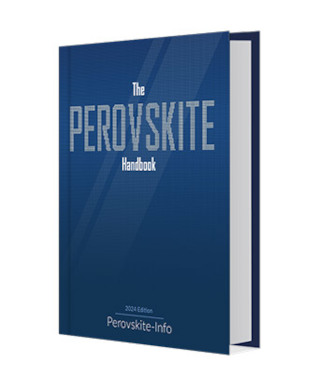
Perovskites offer a myriad of exciting properties and has great potential for the display industry. The promising perovskite industry is currently at a tipping point and on the verge of mass adoption and commercialization and the first display-related perovskites are already reaching the market. You can order the new book here!
According to new reports Samsung is aiming to start installing equipment for its new QD-OLED fab as early as December 2018 - and pilot production will begin in H2 2019.
The EU Lyteus project partners developed a 15-meters long OLED lighting panel
Researchers from the University of Cambridge and Jilin University discovered that radical-based OLEDs feature highly efficient emission.
Universal Display's revenues reached $77.6 million in Q3 with a net income of $22.8 million - but the company lowered its 2018 guidance and disappointed investors.
Google shows how its new dark-mode applications can lower power consumption on OLED smartphones by around 60%
The T7 fab will produce 20,000 monthly OLED substrates - and use an IGZO backplane and inkjet printing deposition.
CLSA says that as OLED displays are too expensive for many smartphone makers and lack enough differentiation to LCDs, the company is lowering its OLED adoption and production forecasts.
As OLED makers aim to compete on the high-end of the market, it is vital to be able to produce the best performing AMOLEDs - and the market standard is set by Samsung Display's Super AMOLED displays.
HiSense's first OLED TV series, the Series X, features 4K 55-inch and 65-inch WRGB OLED panels
The world's smallest travel zoom company camera uses Sony's 0.23-inch 640x400 OLED microdisplays.
The W2019 is a clamshell smartphone with dual 4.2-inch 1080x1920 Super AMOLED displays
An android smartphone with a 6.39-inch 1080x2340 bezel-less AMOLED display and a pop-up selfie camera
The Watch Magic smartwatch features a 1.2-inch 390x390 round AMOLED and a week-long battery
An android smartphone with a 6.39-inch 1080x2340 bezel-less Super AMOLED display and a pop-up selfie camera
An android smartphone with an LCD on the front and a 5.1-inch 720x1520 secondary OLED on the back
Do you have a friend or a colleague that might be interested in OLED technology? Forward this mail to update him on the world of OLED.
If you received this email from a friend, subscribe to this newsletter here!


