The OLED-Info newsletter, February 2018
Published: Mon, 03/05/18


OLED revenues in 2017 reached a record $23.2 billion
DSCC says that OLED revenues reached $8.8 billion in Q4 2017, growing 62% from the previous quarter and 120% from Q4 2016. The main drivers of this growth are shipments for the iPhone X and OLED TV panel growth in the holiday season. In 2017, OLED revenues reached a record $23.2 billion, a growth of 57% from 2016 ($14.7 billion).

UBI Research is even more optimistic, saying that 440 million AMOLEDs shipped in 2017, generating over $27 billion in revenues (a 62.3% increase from 2016). UBI Research sees almost a billion AMOLEDs shipping in 2022, with revenues growing faster to reach $80.5 billion.
IHS Markit says that flexible AMOLED shipments more than tripled in 2017, and revenues reached $12 billion (up from $3.5 billion in 2016). Rigid OLED revenues decreased by 14%. In 2018 flexible OLED revenues will reach around $23 billion, and rigid OLEDs will also increase slightly to about $11 billion.






Apple lowers OLED orders, low fab utilization at SDC
In early 2018, reports started to emerge that Apple's iPhone X orders are lower than estimated, and the Apple is cutting in half its OLED display orders from Samsung (from an estimated 40 million in 1Q18 to 20 million). Samsung is now facing unexpected low utilization at its flexible OLED fabs, and the Korean OLED maker is trying to find new customers for its displays.

DSCC estimates that SDC's flexible OLED fab utilization dropped from almost 100% at the end of 2018 to around 45% today. Samsung's rigid OLED production also dropped from around 80% in September 2017 to 50% today. DSCC sees the situation resolved in the latter half of 2018, but new design wins will start to require panels, but Samsung will not find it an easy task to find customers for its premium OLEDs. CLSA analysts agree on that last point saying that OLED demand from China is softer than expected. We speculate that SDC may choose to target new applications, such as monitor, laptops or maybe large-area transparent signage for its available OLED capacity.
The OLED weakness at SDC is effecting its suppliers as well. UDC reported an excellent 2017, but outlook in 2018 was lower than expected. UDC does say that it expects significant growth to resume in 2109. Coherent also says that the current weakness at Samsung is short lived.
Getting back to Apple, reports now suggest that Apple decided to discontinue the iPhone X and that it will not order parts in H2 2018. We already heard last month that Apple may choose not to introduce another 5.8" OLED iPhone in 2018, but rather go back to an LCD display. Apple is still likely to release a 6.5" OLED iPhone in 2018, but this large variant will probably ship in limited volumes (around 15 million phones) in 2018, and may adopt a P-OLED panel made by LGD rather than a SDC Super AMOLED panel.
The Apple and LG OLED investment that didn't happen
On January 2018 OLED microdisplay maker eMagin announced that it plans to raise $11.5 million in an underwritten public offering, and on the company's filing it mentioned five specific investors - Apple, LG Display, Valve Corporation, Stillwater Holdings and Immerex.
It was widely assumed that Apple and LGD participated in eMagin's financing round, but a few days later eMagin released a statement saying that this is not the case - "As of today, to the Company’s knowledge, none of these consumer electronics companies have taken part in the offering.". eMagin's CFO says that "eMagin listed those companies in the filing because it had discussions with them at industry event".
Samsung denies reports it is developing QD-OLED TVs
In early February ETNews reported that Samsung is developing a hybrid Quantum-Dots OLED technology for its future TVs. Samsung Visual Display Business VP, Han Jong-hee, denied this story, saying that Samsung sticks to its two-track strategy for the high-end TV market, developing both QLED (quantum-dots enhanced LED LCDs) and Micro-LED TVs. Han further says that Samsung will start selling its Wall Micro-LED TV in August 2018.
The ETNews report, though, says that Samsung already produced 55" and 65" prototypes of these new QD-OLED TVs. Samsung uses OLED emitters which are then converted to white light using quantum-dots combined with color filters (QDCFs) to add red and green colors. This seems to be a rather complicated design, but it could be much easier to produce compared to a true RGB OLED TV, as there is no need for precise OLED patterning. A main challenge in such a design however, will be the low efficiency - the current fluorescent blue emitters are not very efficient, and adding color filters further reduces the efficiency of the display.
A new OLED-Info market report covers the PMOLED market
We're happy to announce a new market report: the PMOLED Market Report . This report, brought to you by the world's leading OLED experts, is a comprehensive guide to passive matrix OLED displays (PMOLEDs). The PMOLED market is projected to grow rapidly, fueled by demand from wearables and by flexible and transparent displays, but is overlooked by most analysts focused on the (much larger) AMOLED market.
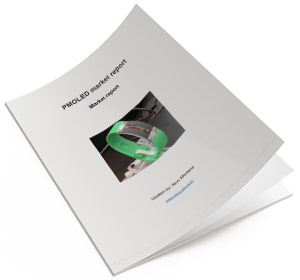
Reading this report, you'll learn all about:
- Applications of PMOLED displays
- Next generation PMOLED technologies
- Flexible and transparent PMOLEDs
- AMOLED vs PMOLED
Meet the OLED-Info team at SID DisplayWeek 2018!
SID's DisplayWeek is the world's leading display conference, and the OLED-Info team will attend this year's event, which will take place in Los Angeles in May 20-25. The trade show brings together a large part of the display industry, and we're looking forward to seeing new OLED technologies, products and demonstrators and meeting up with industry leaders.

We'll be happy to schedule meetings - so if you plan to come to the event, do contact us or simply reply to this newsletter. We're really looking forward to a week full of display technologies!

Germany launched a €9.1 million project to develop lower cost and more efficient emitters based on quantum materials
A display supplier we're in touch with has just received 750 pcs of Samsung's 7.67-inch 1280x800 Super AMOLED Plus displays (circa 2014). - which are now on offer at half their regular price.
A display supplier we are working with in China informed us that they have received a large (8,000 units) stock of CMEL's 2008 2.4-inch 240x320 AMOLED displays. If anyone is seeking replacement displays, this is an excellent opportunity.
According to reports, potential JDI investors are hesitating and the company was not yet able to secure the funds it needs
Japan-based chemical producer Nagase announced that it invested ¥500 million Yen ($4.6 million USD) in Hyperfluoresence TADF materials developer Kyulux
Cynora presented a new 21% EQE and 10 hours LT97 deep blue, says it will meet its customer specifications in the coming months
Reports from Korea suggest that LGD ordered the first batch of 10.5-Gen deposition equipment for its upcoming P10 OLED TV fab, which will be complete in the first half of 2018
Universal Display announced that it has signed long-term OLED material supply and license agreements with Samsung Display. The agreements are scheduled to run through December 31, 2022, and may be extended for an additional two-year period.
The agreement will see a complete technology transfer, including production line deployment and supply of materials. SmartKem updates us that this agreement covers both LCD and OLED displays.
In early 2018 Samsung unveiled its 146-inch modular Wall Micro-LED TV, and LG Display, it seems, aims to unveil its first Micro-LED TV in September 2018 - and it will be larger than the Samsung Wall.
Vivo demonstrated a new concept device called the APEX, that includes several new innovative technologies - including an almost bezel-less flexible AMOLED display
China's Visionox produced the new notch-type 6.21-inch 2160x1080 panel that is adopted by Doogee to create a smartphone with very high screen-to-body ratio (94.85%)
Samsung's 2018 flagship smartphones will use 5.8-inch (6.2-inch on the S9 Plus) 1440x2960 (570 / 529 PPI) flexible Super AMOLED displays
Nokia's flagship 2018 phone will sport flexible edge-type 5.5-inch 1440x2560 P-OLED displays made by LGD
Do you have a friend or a colleague that might be interested in OLED technology? Forward this mail to update him on the world of OLED.
If you received this email from a friend, subscribe to this newsletter here!


