The OLED-Info newsletter, January 2018
Published: Thu, 02/01/18


On Apple's iPhone X sales and SDC's OLED production
According to several sources, Apple experienced a decline in iPhone X shipments, and some estimates say that Apple halved its component orders for Q1 2018 compared to earlier estimates as /a>Apple expects now to ship only 20 million iPhone X in Q1 (down from 40 million). Analysts expected Apple to introduce two new OLED iPhone models in 2018, but now it seems that Apple is considering to cancel the smaller 5.8-inch 2018 OLED iPhone and only release the larger 6.5" one.

All this is bad news for Apple's suppliers, and Samsung Display is no exception - as it is Apple's exclusive OLED supplier. The situation may be actually quite dramatic for Samsung as according to some reports LG Display was selected to supply the 6.5" OLED for the large iPhone 2018 model - which is possible because Apple is said to expect to sell around 15 million such phones in 2018 and LGD will have enough capacity.
At the end of January 2018 Samsung reported its financial results for 2018, and SDC's results were very good as the company saw increased OLED shipments for premium smartphone. The company however warned that in Q1 2018 there will indeed be a decline in OLED shipments due to a "certain customer". The company's business will not be affected much though, as SDC will seek new customers. According to ETNews SDC's utilization rate at its A3 flexible OLED fab has fallen more than 10% recently - and that Apple's share of the A3 capacity was 77%.
SDC's OLED problems are not only in its flexible OLED fabs, though. Samsung acknowledged that several smartphone makers in China have opted for lower high-end LCDs and its rigid OLED sales is also slowing down. According to ETNews, Samsung recently had to reduce the utilization rate at its rigid OLED production lines (A1 and A2) to half due to low demand for rigid OLEDs as phone makers adopt lower cost LTPS LCDs. Samsung may choose to convert some of its rigid OLED lines to flexible OLED production.






ASUS is JOLED's first printed OLED customer
JOLED announced that its OLED panels were adopted by Asus for its first OLED monitor, the "portable" ProArt PQ22UC. JOLED's ink-jet printed monitor is a 21.6" 3840x2160 (204 PPI) OLED. JOLED indeed announced in December 2017 that it started commercial production of 21.6" ink-jet printed 4K OLED panels, and it is great to see a product launched so quickly. JOLED's production capacity is not large, the company is still using a pilot-scale line, but it's likely that Asus is not expecting to sell many units of this high-end OLED monitor.

JOLED is now seeking to raise $900 million to support its plan to start mass producing OLEDs in 2019. According to reports, JOLED received funding commitments from Sony and Panasonic, with both Sumitomo Chemical (who supplies its P-OLED materials to JOLED) and Screen Holdings (who supplies its equipment to JOLED) are likely to take part in the financing round as well. Each of these four companies will invest between $45 to $90 million. Automobile parts maker Denso is considering a $440 million investment in JOLED as well. For more information on JOLED's technology click here.
New OLED TVs unveiled at CES 2018
At CES 2018, several companies introduced their latest OLED TVs. First up is LG Electronics, with its new 2018 OLED lineup. LG updated all of its models, except the OLEDG7 which will not get a successor in 2018. All the TVs are based on new a9 "intelligent processor" that promises better color and fast smart TV (webOS) operations - except the entry-level B8 which uses a scaled-down version of the chip. The OLEDW8 will be LG's flagship TV for this year, a wallpaper design OLED TV. The other new models are the OLED-on-glass OLEDE8 , the basic OLEDC8 and the entry level OLEDB8.

In addition to its new OLED TVs, LG also demonstrated an exciting new prototype - a 65" rollable OLED TV that comes with a base that holds the TV when it is rolled away. This is a prototype display, and it's likely that LGD has no immediate plans to actually release such a display - last year LGD did say it plans to bring rollable OLED TVs to market by 2020. You can see this rollable OLED wonder in a video here. In addition to this exciting prototype, LGD also unveiled its largest OLED ever, a 88-inch 8K OLED display
.Panasonic also announced its new OLED TVs for 2018, the the FZ800 and FZ950. Both TVs offer the same 55" and 65" 4K WRGB (LGD) OLED panels, and feature Panasonic's latest HCX processor, dynamic LUTs, Dolby Vision, HDR10+, Dynamic Scene Optimizer and extreme 2.5% calibration levels. The FZ800 comes with built-in speakers, while the FZ950 offers a Technics-branded 80 Watt Dynamic Blade soundbar.
Philips (TPVision) announced its OLED TV lineup for 2018. Philips will offer three models, the OLED 973, OLED 873 and OLED 803. All of these 2018 TVs will be pretty similar, and all will feature 4K WRGB OLED panels, Philips' P5 "Perfect-Picture" processor, 3-sided Ambilight, HDR10, HLG and HDR10+ (will arrive in Q2 2018), Quad-core Android TV platform with Google Assistant and 16GB of memory.
Sony also announced its 2018 OLED TV, the AF8 - a premium TV series (55-inch / 65-inch) that feature Sony's X1 Extreme picture processor (used in the 2017 A1E), Sony's Acoustic Surface tech (which was also used in the A1E, but the AF8 uses a new stand design), HDR10, HLG and Dolby Vision. The AF8 will support Google and Amazon voice recognition technologies.
China's Changhong demonstrated several OLED TV prototypes and products at CES. One of the TVs employs a similar design to Sony's 2017 A1E with the Acoustic Surface back stand. Skyworth announced that it will introduce new AI-chip powered OLED TVs in 2018, but it did not demonstrate these yet. Finally China-based HiSense announced that it will release its first OLED TV in the first half of 2018.
Samsung unveils its first Micro-LED TV
Samsung unveiled its first Micro-LED TV at CES, aptly named "The Wall". This is a 146-inch tiled 4K display that is almost 8 times larger than a 55" TV in area. We don't have any technical details yet on this display, but according to reporters at CES you cannot see the seams of the individual tiles.
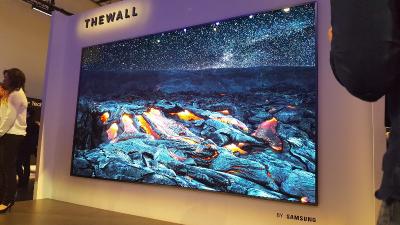
Samsung says that this display will ship in 2018 - but it did not reveal the price or expected release date. It's also not clear whether you will be able to actually customize this display with smaller and/or larger sizes. Samsung is looking for a new premium TV technology as its QLED TVs failed to keep up with LGD's OLED TVs, and has seen its premium TV market share fall from 57% in 2015 to 20% in 2016 (LG, meanwhile, managed to increase its market share from 17.5% in 2015 to 43% in 2016).
Samsung to start producing 7.3-inch foldable smartphones in November
Samsung has been developing foldable display technologies for a long time, and it seems that a foldable phone/tablet is always just around the corner. In September 2017 Samsung's Mobile Business group President says that it hopes to have a foldable phone in the market in 2018, and according to new reports from Korea Samsung is now expected to start production in November 2018. The phone will have a 7.3-inch display that folds inside.
The Korea Herald reports that the foldable phone will be introduced in December 2018 or early next year. Samsung Electronics already finished the phone's design and specification, and Samsung Display is expected to complete the display development by March 2018. The actual panel production will commence in September 2018.
OLED equipment spending reached a record $15.5 billion in 2017
Display Analysts from DSCC says that 2017 was a record year for the display equipment market, with revenues reaching a record $24.7 billion (up 30% from 2016). OLED spending reached a record $15.5 billion - a 143% increase over 2016. Samsung's share of the OLED equipment market was 48%, followed by BOE with $24% (following a 229% growth from 2016).

In 2018 DSCC sees the equipment market falling 9%, although booking will increase as growth will resume in 2019. The main reason behind the decline in 2018 is due to Samsung which will reduce its equipment orders by 64% in 2018. 2018 is expected to be the first year where China leads in OLED spending with a 64% to 36% advantage over Korea.
OLED-Info updates its market reports
In January 2018 we published new editions of our market reports - that cover the flexible, VR/AR, microdisplays, automotive and graphene OLED markets. OLED-Info provides comprehensive niche OLED market reports, and our reports cover everything you need to know about the niche market, and can be useful if you want to understand how the OLED industry works and what this technology can provide for your own industry.
Our market reports come with one year of free upgrades. If you bought your report within the year, contact us to get your new edition. Older customers are entitled for an upgrade discount, please contact us for more information.
OLED Ink-jet printing market situation, early 2018
Ink-Jet printing has always been seen as a way towards lower-cost OLED production, and in recent years it seems that the main challenges in this technology have been overcome. It seems that at least four groups (in Korea, Japan and China) are charging forward towards mass production of ink-jet printed OLEDs. In fact Japan's JOLED has recently started commercial production of printed OLED monitor panels.

Korea's Cetizen posted an interesting review of the burn-in of 3 flagship OLED phones, the iPhone X, the S7 Edge and the Note 8
According to reports, LG Display is set to sign an agreement with Apple to supply 15-16 million 6.5-inch flexible OLED displays for Apple's 2018 large OLED iPhone
Financial analysts from CLSA say that according to their checks, the ramp-up at the B7 is ahead of schedule, and CLSA expects BOE to ship 19 million smartphone OLEDs in 2018 and 41 million panels in 2019.
Universal Display's agreement with Samsung Display expired on December 31st 2017, discussions are still on-going
LGD reported its financial results for Q4 2017. LGD says that it solidified its OLED business, increased its annual OLED TV shipments to 1.7 million units and started production of flexible OLEDs at its E5 production line. The company aims to start production in its E6 line in Q3 2018.
Samsung's latest VR display offer a very high density - 615 PPI. Let us know if you are interested in these new VR AMOLEDs!
According to IHS, OLED TV shipments reached 270,000 units in November 2017 and 1.4 million in the whole of 2017
According to reports Sony signed an agreement with LG Display for the supply of flexible OLEDs for its next flagship phone
Sharp already started to sample flexible OLEDs, and aims to supply such displays for its own smartphones in the spring of 2018
Following a year-long collaboration with Synaptics, Chinese phone maker Vivo has unveiled the first device to use Synaptics Clear ID, the Vivo X20 Plus UD
Our recent article discusses PWM and its effects on OLED display
Looking for a great OLED domain for your business? We offer some top-quality domains for sale here at OLED-Info
The PQ22UC is a portable monitor with a 21.6-inch 3840x2160 printed OLED display (made by JOLED)
A mobile head-mounted-display (HMD) that uses Kopin's 0.49-inch 1280x720 OLED microdisplays
A premium upgrade to HTC's popular VR headset, the Vive Pro uses dual 3.5-inch 1440x1600 SDC VR AMOLEDs
A budget smartphone with a 5-inch qHD (540x960) Super AMOLED display
A high-end gaming laptop with an optional 13-inch AMOLED display
An Android Wear 2.0 smartwatch with a round AMOLED display
Elephone's high-end smartphones use a 5.99-inch 2160x1440 flexible OLED displays, reportedly supplied by BOE Display
The world's first phone to use an under-the-OLED fingerprint sensor, the X20 Plus UD has a 6.43-inch 1080x2160 Super AMOLED display
Sony's 2018 OLED TV sports a 55-inch or 65-inch 4K WRGB OLED.
LG's flagship wallpaper TV, the OLEDW8 comes in either 65-inch or 77-inch and is powered by LG's new a9 intelligent processor
LG's high-end on-glass OLED TV for 2018, the OLEDE8 (55-inch or 65-inch) features LG's new a9 intelligent processor, HDR, 4K HFR and Dolby Atmost
One of LG's basic 2018 OLED TV model, the OLEDC8 (55, 65 or 77 inch) features 4K HDR, HFR and LG's new a9 intelligent processor
LG's entry-level 2018 OLED TV, the OLEDB8 (55-inch or 65-inch) features HDR, 4K HFR and Dolby Atmos
Philips' entry-level OLED TV for 2018, the 55-inch and 65-inch 803 features Philips P5 processor, 3-sided Ambilight and an Android TV platform.
Philips' 873 is a 65-inch 4K OLED TV that features Philips P5 processor, 3-sided Ambilight and an Android TV platform.
Philips' flagship OLED TV for 2018, the 65-inch 973 features Philips P5 processor, 3-sided Ambilight and an Android TV platform.
Panasonic's flagship TV for 2018, the FZ950 is 55-inch or 65-inch 4K OLED TV with Panasonic's latest HCX processor.
A 4K 55-inch or 65-inch OLED TV expected by the spring of 2018
Do you have a friend or a colleague that might be interested in OLED technology? Forward this mail to update him on the world of OLED.
If you received this email from a friend, subscribe to this newsletter here!


