The OLED-Info newsletter, November 2017
Published: Tue, 10/31/17


BOE starts mass producing flexible AMOLED idsplays
China-based BOE display started to mass produce flexible OLED displays at its Chengdu B7 fab, and the company held an official ceremony during which it demonstrated its first batch of flexible OLED panels, and delivered samples to representatives from Huawei, Oppo, Vivo, Xiaomi and others Chinese phone makers - although its not clear whether any of these are already acquiring panels. According to ETNews Huawei will be BOE's first flexible OLED customer.

The first panels produced by BOE are 5.5" in size with a resolution of 1440x2560 (QHD) - these are smartphone panels that will be adopted in an edge-type configuration. BOE says that its production line is highly automated, and BOE's panels come with a touch layer already laminated. The whole panel is just 0.03 mm thick. BOE demonstrated several panels, including edge-type displays, foldable displays and curved panels. You can see these display prototypes here.
BOE's B7 fab is the company's first flexible AMOLED line. The full capacity is 48,000 substrates per month, but this will only be achieved in the first half of 2019. Earlier reports suggested that BOE's capacity will be very low, around 10,000 panels per month, but CLSA estimates that BOE will ship around 2 million panels by the end of the year as it can already produce 16,000 monthly substrates (of course we do not know the fab's production yields yet).
The total cost of the B7 fab is estimated at 46.5 billion Yuan (almost $7 billion USD). In addition to this fab in Chengdu, in October 2016 BOE announced another 6-Gen OLED fab, in Mianyang. The Miangyang fab will have a similar capacity (45,000 sheets per month) and will enter production in 2019. Total investment in the Miangyang fab is estimated at 46.5 billion yuan as well.







Consumers complain about LG's first batch of P-OLED displays
LG Display's first batch of smartphone OLED displays (6-inch 1440x2280 P-OLEDs) have been adopted in LG's own V30 and Google's Pixel 2 XL. Both reviewers and customers complain about bad color reproduction, graininess and problematic viewing angles. In addition many users seem to report serious image retention issues.
This is obviously a big disappointment. LG did manage to produce excellent P-OLED displays for Apple's Watch, but seems not to be able to have good enough quality control for its new larger displays. In August we reported that LGD is still facing very low yields at its 6-Gen E5 line, and so has to produce the V30 displays at its Gen-4.5 flexible AMOLED line. LGD confirmed this by the end of October, saying that the first products to use OLEDs out of the E5 line will launch at the end of 2017.
Google issued an official response, of sorts. The company will be adding a new software mode that will offer more saturated colors, and it extended the warranty to 2 years. It says that image retention at the Google 2 XL is similar to other OLED displays on the market. Google did not respond to other display quality complaints (graininess, viewing angles, uneven color brightness and more). For more about Google's response and our own views see here. See the story below for more about image retention and LG's new displays...
On Burn-In vs Image-Retention and LG's new P-OLED displays
Following users and reviews complains about image retention issues at LG's new P-OLED displays, we set out to explain what is burn-in, the difference between burn-in and temporal image-retention and also try to shed some light on LG's latest OLED problems. Read our article to learn whether there is any difference between LCD and OLEDs regarding image retention, DisplayMate's view on the matter, Samsung's own image-retention marketing campaign and how display makers are trying to solve these issues.
Market analysts bullish on OLED displays
In the past few weeks several market analysts have posted updated market forecasts, seeing a larger OLED market going forward. First up is DSCC who has updated their OLED models, as the company sees more capital spending then before. The OLED market in general will grow 57% in 2017, according to DSCC, to reach $23.2 billion. Growth will continue to be strong with a 50% increase in 2018 (to $34.9 billion) and a CAGR of 27% from 2016 to 2022. In 2022 the market will surpass $60 billion. For more information on DSCC's forecast, click here.

IHS Markit says that global AMOLED production capacity is set to grow from 11.9 million square meters to 50.1 million sqm in 2022 - that's a 320% growth in 5 years. Samsung and LGD will remain the market leaders and Korea will have a market share of 71% in 2022 (down from 93% in 2017). China-based OLED makers will have a market share of 26% in 2022 (up from 5% in 2017). For more on IHS's take on the market, click here.
Samsung itself, after posting an excellent quarter, expects to grow its OLED sales based on increased shipments of flexible and rigid products. For 2018, Samsung expects OLED products to become mainstream in the smartphone industry, especially as flexible panels increase within high-end devices.
Are LCDs now "good enough" for VR applications?
Currently pretty much all high-end HMD devices adopt OLED displays as these panels offer faster refresh rates compared to LCDs. But US-based video game developer Valve says that recent LCD advancements combined with VR specific calibration now make LCD a viable technology choice for high end VR systems. Valve says that LCD makers have demonstrated "fast-switching liquid crystals, low persistence backlights, and high PPI displays" that can match the highest-quality VR experiences when calibrated and paired with the right software.
Oculus (Facebook) announced its new affordable VR headset, the Oculus Go. This $199 device will launch early next year for $199 and Facebook hopes that this will be a step towards its goal to get one billion people to use its VR products. One of the ways that Oculus used to lower the cost of to Go headset is to switch from an OLED to an LCD. Oculus says that this is a "fast-switch LCD", and the company apparently thinks that LCDs are now viable for VR applications.
Innolux starts producing small flexible AMOLED displays
Taiwan-based Innolux has started to produce flexible AMOLED displays, starting with a round 1.39-inch 400x400 (287 PPI) panel. The new AMOLED is aimed towards wearable (smart-watch) applications and is now in mass production.
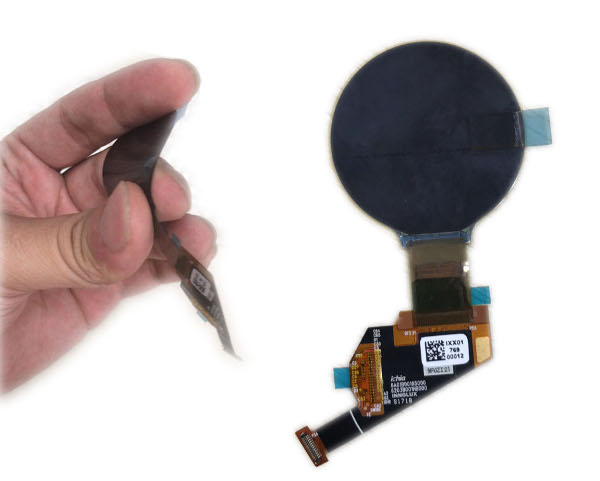
It is great to see another display producer entering the OLED market. This is also the first flexible AMOLED on the market besides those made by Samsung and LG Display. Innolux is willing to sell these panels to low-volume customers, contact or reply to this mail us for more details. You can also view the full technical specifications of the new AMOLED here.
OLED-Info releases updated editions of its OLED market report
In early October we published new versions of our market reports - that cover the flexible, transparent, VR/AR, microdisplays, automotive and graphene OLED markets. OLED-Info provides comprehensive niche OLED market reports, and our reports cover everything you need to know about the niche market, and can be useful if you want to understand how the OLED industry works and what this technology can provide for your own industry. The reports are now updated to October 2017.
Our market reports come with one year of free upgrades. If you bought your report within the year, contact us to get your new edition. Older customers are entitled for an upgrade discount, please contact us for more information.

OTFT maker SmartKem recently made headlines as it started its commercialization phase, we discuss the technology and business with its CEO
Wisechip says that its 1-inch ICT PMOLED will be cheaper by about $1 compared to current touch PMOLEDs, and will also be thinner and lighter.
Samsung is reportedly looking for alternative technologies to its Q-LEDs as it fails to increase its market share in the premium TV segment
Researchers from Kyushu University has demonstrated the world's first glow-in-the-dark material that is made completely from organic materials
Reports from Korea suggests that LGD is developing foldable OLED technologies, with an aim to produce commercial panels by 2020
Both Japan Display and JOLED require more funds to initiate OLED production, seeks help with Korean and Chinese companies
LG Electronics says that it is supplying the OLEDs for Mercedes' 2018 S-Class Coupe and Convertible
Samsung has confirmed plans for its new OLED fab, but capacity may be lower than expected
LG Display announced that it has shipped over 200,000 OLED TV panels in September, over double the volume compared to September 2016. LGD is seeing high demand for its OLED TV panels, mostly from LG Electronics and Sony.
UK researchers report that they have demonstrated a viable graphene solution comparable to existing commercial OLED encapsulation technologies
Visionect says that since the launch of the e-paper powered JOAN series last year it has signed on over 1,600 customers in North America alone with thousands of devices deployed worldwide.
As the year is coming to an end, we are happy to offer a special discount for new advertisers and sponsors. Sign up now to also get the rest of 2017 at no cost - that's over two extra months! Reply to this mail or contact us for more details.
Samsung's Odyssey is a premium Microsoft-VR platform HMD that uses dual 3.5-inch 1440x1900 90Hz VR AMOLED display
Google's flagship smartphone features an SDC 5-inch FHD (441 PPI) Super AMOLED display
Google's large flagship smartphone features an LGD-made 6-inch QHD+ (537 PPI) AMOLED display
A lightweight AR platform that uses 640x400 OLED microdisplays
Canon's latest flagship compact camera sports an XGA OLED viewfinder
Huawei's flagship smartphone uses a 6-inch 1080x2160 AMOLED display
Part of Noon's home layered lighting system, the director switch uses a 1.45-inch 280x280 AMOLED touch display.
Do you have a friend or a colleague that might be interested in OLED technology? Forward this mail to update him on the world of OLED.
If you received this email from a friend, subscribe to this newsletter here!


