The OLED-Info newsletter, June 2016
Published: Tue, 07/05/16


LG OLED TV updates
June was a busy month for LG's OLED TV unit. At the top of the line, LG started to ship its 77" Signature G6 OLED TV - for $24,500. I have seen this 77" OLED TV at SID 2016, and it is truly stunning.. LG also announced prices and started shipping its basic OLED TV 2016 models.
So first up with the OLED B6- the 55" OLEDB6 costs $2,797 while the 65" model costs $3,999. Both are now shipping. LG's OLED C6, which are similar to the B6 - but in curved form, cost the same - the 55" OLEDC6 costs $2,799 while the 65" model costs $3,999. LG also shaved off $500 from its higher end 65" OLEDE6 - which now costs $5,499.
In January 2016, LG announced that it will invest $380 million to double its OLED TV production capacity - by building a new production line with a capacity of 25,000 substrates per month. The new line will be completed by Q2 2017. According to the Korea Herald, LG started to execute this plan, and have ordered new production equipment from Korean suppliers. LG will replace the LCD production line at its P8 plant in Paju and will move the current equipment to its Chinese plant in Guangzhou.
In an interesting story about how LG Electronics OLED quality control - and how the company tests its OLED TVs before shipping, the Korean company also reveals that its latest OLED TVs feature a lifetime of 100,000 hours - or 30 years of 10 hours per day. In 2013, LG's OLED panels had a lifespan of about 36,000.




Graphene for displays and lighting - new research results
Graphene is a very interesting material for displays and lighting, and in the past few weeks several new research results involving graphene were published. First was researchers from Turkey that demonstrated a display prototype that is printed on paper - using graphene inks. To create this display, the researchers used electro-modulation of the optical properties of the multilayer graphene via blocking the interband electronic transitions
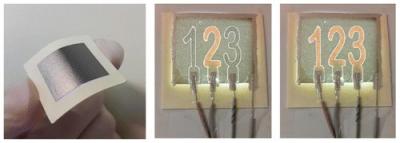
Researchers from Korea's ETRI Institute developed the world's first transparent OLED prototype that uses a graphene transparent electrode. A prototype display was demonstrated at SID 2016 last month. The prototype display was 26x26 mm in size, with a resolution of 155x60. In a different research from Exeter University, GraphExeter (a material derived from graphene) was found to be an
excellent electrode material for electroluminescent devices - brighter than pure graphene by almost 50%.
Earlier in June, Researchers from Korea's KAIST institute reported on a rollable OLED device that uses graphene-based electrodes. The researchers say that the new OLED is much more durable when bent compared to current devices made with ITO electrodes. The electrodes were made from a stack of materials - titanium oxdies, graphene and conductive polymers. The new OLEDs were
also brighter than current devices, and with a higher color gamut. This was achieved by maximizing the resonance within the OLED.
New market forecasts from IHS, UBI and Digitimes
IHS estimates that 90.8 million OLED panels shipped in Q1 2016, and most of these (87.35 million) used in smartphones. 2 million panels were used in smartwatches. SDC is still the clear OLED leader, with a market share of 97.7%. LGD follows with 0.9% and AUO with 0.7%. Regarding OLED TVs, IHS expects 830,000 OLED TVs to ship in 2016. The market will grow to 1.4 million in 2017 and 5.8 million in 2020. IHS lowered its OLED TV forecasts as it does not see Samsung returning to the OLED TV market, and because of limited mass production capacity.
UBI Research has pretty much the same estimates: the total OLED market reached 91.3 million units in Q1 2016, and Samsung Display produced about 86.7 million panels (95% of the total OLED market). UBI further estimates that Samsung produced 12.1 million flexible OLEDs for its Edge-type phones (14% of its total OLED shipments).
Digitimes Research expects that Samsung Display will remain the leader in mobile-device AMOLED displays, and the Korean company will increase its AMOLED shipments to 560 million panels in 2019. Samsung Electronics will remain the company's largest AMOLED customer, but most of the growth in AMOLED shipments will come from other clients. SDC will ship 239 million AMOLEDs to Samsung Electronics in 2016, and this will grow to 290 million units in 2019.
Digitimes further estimates that Apple will ship 40 million OLED iPhones in 2017, and this will grow to 80 million in 2018 and 120 million in 2019. (UBI estimates that Apple will become the world's largest OLED customer in 2021). OLED shipments to China-based smartphone makers will grow from 99 million 2016 to 150 million in 2019. If we combine Digitimes estimates of 239 million OLEDs shipped to SE and 99 million shipped to China-based customers, it ends up as if Digitimes estimates 338 million AMOLEDs being produced in 2016.
ODG's Project Horizon
San Francisco based Osterhout Design Group (ODG), makers of the R7 enterprise-bound AR / VR smartglasses, is developing a new AR / VR platform that is based on OLED microdisplays. The so-called Horizon Platform offers a wide-field of view, 4K 3D content @ 120 fps and can switch between VR and AR modes. The resolution is 2K x 2K for each eye.
It's highly likely that this future platform is based around eMagin's 2K x2K OLED microdisplays - as far as I know eMagin is the only OLED microdisplay maker that offers such a resolution. In January 2016 eMagin announced it has signed a non-exclusive IP licensing agreement for its HMD technology with an undisclosed company. The deal included an upfront $1 million licensing free, and a commitment to use eMagin’s OLED microdisplays in the company’s headsets.
SDC to increase OLED production capacity
According to the Nikkei Asian Review, Samsung decided to increase its OLED production capacity by over 50% in the near future as it aims to start supplying Apple and other mobile device makers with AMOLED panels. Samsung Display will invest around $6.8 billion in 2016 to boost capacity, which will translate to a yearly capacity of over 200 million smartphone-sized panels.This seems to be a very optimistic plan - to be able to increase capacity so quickly...
A few days before the Nikkei AR report, Business Korea said that SDC's new chief has quickly started to change the direction of the company, to focus on flexible OLEDs and dispose of some of the loss-making LCD business. According to the that report, Samsung decided to covert at least some of its L7 LCD lines to flexible OLED lines in a $2.56 billion investment by the end of 2017.

Samsung is currently producing around 9 million flexible OLEDs each month to satisfy demand for the Galaxy S7 edge and its other flexible OLED products (such as the Galaxy S6 edge+ and several wearables) - and also for other companies.
Tokki to double its OLED equipment capacity
As the OLED market is quickly expanding, we see massive investment in production capacity, mainly from Korea and China. According to Reuters, Canon Tokki, the leading vacuum evaporation equipment maker, is experiencing a boom in orders. Tokki has a large order backlog - worth several years of its current production capacity. According to some reports, Tokki has turned down orders from LG Display recently as Samsung has taken up all of its capacity - and so LG had to order equipment from Tokki's competitors (mainly SFA Engineering and Ulvac).
Tokki now plans to double its production capacity in 2016. The company's CEO says that the market is "flourishing on news that Apple is expected to adopt OLEDs" .
Are Micro-LEDs becoming an OLED alternative?
Micro-LED is a very interesting technology that has some real advantages over OLED displays, especially in efficiency, lifetime and brightness. Those displays are still very challenging to actually deposit, though. Despite that, Sony unveiled a large tiled outdoor 9.75 x 2.74 meter 8Kx2K display based on the company's micro-LED technology, called Crystal LED. According to Display Daily's reported, the image quality is stunning. This is a tiled display, but almost seamless.
The first-generation Apple Watch uses a flexible OLED display, exclusively produced by LG Display. Digitimes now says that Apple is developing a Micro-LED panel to be used in a future Watch - to be released in H2 2017. Apple acquired Micro-LED developer LuxVuew in May 2014, and according to this report. has setup a micro-LED research lab in Taiwan in 2015.
SID 2016 summary
The premier display industry conference, SID DisplayWeek 2016 took place at the end of May 2016 in San Francisco. This was a very interesting trade show, and OLEDs too center stage as the technology matures and is set to become the leading display technology in the near future. We published several posts following our meetings and booth visits at SID:
- LG Display: several new OLED technologies, and the amazing 77" Signature OLED TV
- Samsung Display: rollable OLED demonstration
- Samsung Display: healthier bio-blue OLED prototypes
- Samsung Display: 806 PPI AMOLEDs for VR applications
- Samsung Display: new automotive-bound transparent and mirror OLEDs
- Samsung Display: laptop-bound AMOLED displays
- Japan Display: flexible OLED display prototypes
- BOE Display: several new OLED prototypes
- TianMa: flexible and rigid OLED prototypes
- SEL: TR-Hybrid OLED/RLCD display
- E-Ink: Beautiful new color e-paper displays
- nVerPix: CNT-based OLET display prototype
- Kateeva: $88 million to advance its ink-jet printing system
- Kyulux: advancing fast to commercialize TADF emitters
- Solomon Systech: AMOLED and OLED lighting drivers
- Futaba: automotive and flexible PMOLEDs on display
A new OLED-Info market report, OLED for VR and AR
We're happy to announce a new market report: OLED for VR and AR. This report, brought to you by the world's leading OLED experts, is a comprehensive guide to OLED displays for the VR and AR markets. OLEDs have a bright future in VR and AR - and our new report discusses the future of these two emerging and fast-growing markets.

Reading this report, you'll learn all about:
- Why OLEDs are adopted in almost all VR HMDs
- What kind of displays are required for VR and AR applications
- What the future holds for the VR and AR markets
- Current and future VR and AR systems
The report also includes:
- VR/AR market forecasts from leading analysts
- VR and AR OLED companies overview
- Datasheets and details on leading OLED VR microdisplays
- Free updates for a year
Get the report now for $299.99 (single-user license), and $999.99 for an enterprise license - which can be shared with your entire organization. You can find out more information and download the report here.
Leaked photos spark stories about an OLED touchpad for the next-gen MacBook Pro
Researchers from Taiwan's ITRI developed a foldable AMOLED display - which fold both inwardly and outwardly. ITRI will transfer this new technology to Chunghwa Picture Tubes (CPT) in Q4 2016.
HP's Spectre x360, with a 13.3-inch 2560x1600 AMOLED display, is now shipping for $1,499.
According to Bloomberg, Samsung aims to release two kinds of foldable phones - a regular-sized phone that folds into a small device, and another regular-sized phone that opens up to become a 8-inch tablet
During a tradeshow, NEC demonstrated a 55-inch FHD AMOLED, using panels made by LG Display, no doubt.
Universal Display paid $96 million for BASF's 500+ issued and pending patents - following 15 years of OLED R&D
Foxconn aims to have Sharp starting to produce OLEDs in 2017 (in time for Apple's first OLED iPhone?) but this won't be an easy task
OLED-Info has been providing objective and up-to-date OLED market news, as well as in-depth articles and commentary for over 10 years. We are now happy to offer the opportunity to embed our OLED news directly in your web site, at no cost.
The Gear Fit2 is a high-end Tizen-based fitness tracker is a curved (flexible) 1.5-inch 216x432 Super AMOLED.
Xiaomi's Mi Band 2 is an affordable ($23) fitness tracker with a 0.42-inch white PMOLED
A mid-range smartphone with a 5.2-inch FHD Super AMOLED display
A large mid-range smartphone with a 5.7-inch FHD Super AMOLED
A high-end smartphone with a 5.5-inch QHD AMOLED display
Asus' ZenFone3 Deluxe features a 5.7-inch FHD Super AMOLED display
The Axon 7 has a large 5.5-inch 1440x2560 AMOLED display
One Plus' 4th generation smartphone has a 5.5-inch FHD Optic AMOLED (Super AMOLED)
The 2nd-gen open-source VR HMD dev-kit uses a 2160x1200 OLED display
Do you have a friend or a colleague that might be interested in OLED technology? Forward this mail to update him on the world of OLED.
If you received this email from a friend, subscribe to this newsletter here!


