The rapid evolution of display technology requires the use of cutting-edge research methods to maintain progress. Industry innovators such as Panasonic, Samyang, and Samsung are adopting Schrödinger’s digital chemistry platform to drive innovation in their organic electronics R&D.
This webinar, “Leveraging atomistic simulation, machine learning, and cloud-based collaborative ideation for
display materials discovery” will explore the union of physics-based simulations, machine learning (ML), and cloud-native collaboration and informatics tools in revolutionizing R&D innovation for display materials.
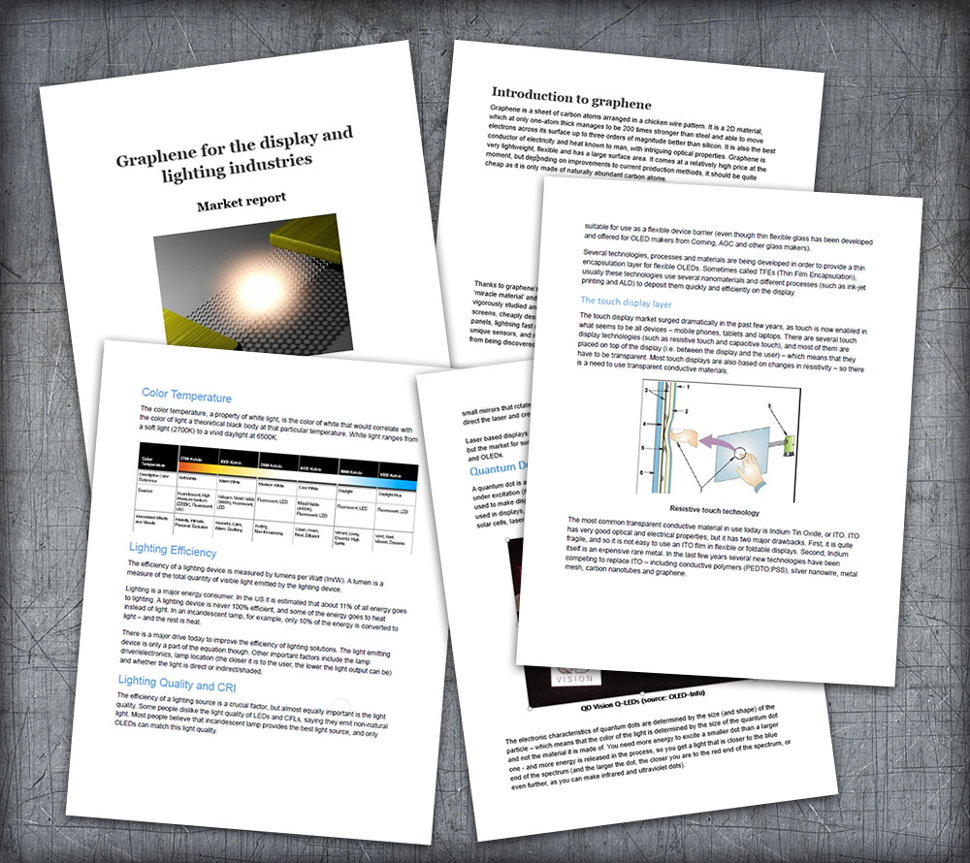
Today we published a new edition of our Graphene for Displays and Lighting Market Report, with all the latest information. Graphene has high potential to improve LCD, OLED and MicroLED displays and
can be used to enhance displays backplanes, electrodes, heat dissipation, emitters and more. In addition graphene can increase efficiency in lighting devices and improve designs.
Reading this report, you'll learn all about:
Graphene applications in LED and OLED lighting
Graphene's adoption as a backplane for AMOLEDs
Transparent
graphene electrodes
Graphene-based encapsulation development
The report package also provides:
Graphene companies involved with display and lighting
An introduction to graphene
An introduction to lighting and displays
Details about graphene for QDs, lasers and thermal foils
This market report provides a great introduction to graphene solutions for the display
and lighting markets, and covers everything you need to know about graphene technologies in these niches. This is a great guide for anyone involved with the displays and lighting.
Honor's MagicPad 2 android tablet offers a 12.3" 144Hz 1,600 nits 1920x3000 AMOLED display, a Snapdragon 8s Gen 3 chipset, up to 16GB of RAM and up to 1TB of storage.
The MagicPad 2 will ship by the end of July 2024, starting at around $400.
According to Omdia, sales of OLED panels in sizes over 9-inch (the company refers to these as Large Area Displays) will increase
124.6% in 2024. In 2023, the market contracted 25.7%, with the only exception being OLED monitor panels that grew in shipments.
In 2024, Omdia says that all application areas will see an increase in shipments - TVs, monitors, tablets and
laptops. Only the company's "other" category will see a decrease in sales. In particular, tablet OLED shipments are projected to increase by 294% compared to 2023, largely due to Apple's adoption of OLEDs in the 2024 iPad Pro tablets. Laptop OLED sales will increase 152.6%, and monitors OLEDs will increase 139.9%. Finally, OLED TV panel shipmens will increase 34.8%.
Samsung announced today four new devices - two foldable smartphones, and two smartwatches, all with AMOLED displays. All of these devices will ship on July 24.
First we have the latest clamshell smartphone, the Galaxy Z Flip6 - that has a foldable 6.7" 120Hz 2,600 nits 1080x2640 LTPO AMOLED display. It also has a 3.4" 720x748 Super AMOLED cover display.
In recent years, the focus of the industry, beyond increasing capacity and reducing production costs, has been improving the performance of OLEDs in the areas of display brightness, efficiency, and lifetime. Brightness is required in many applications - from TVs (for HDR and to view in ambient lighting) through smartphones (outdoor viewing) to automotive, and efficiency is a plus in any scenario (but mostly in mobile displays). Display lifetime is already good
enough for many applications, but in some cases (like automotive, and IT displays) it is critical. These three properties usually go together - if you can make more efficient OLED displays, you can drive them at a lower current to achieve the same brightness, and so lifetime increases, or you can achieve higher brightness, etc.