The OLED-Info weekly newsletter
Published: Tue, 02/08/22



The OLED-Info newsletter (February 8, 2022)
Cannot read this? View it online here
Toray Research Center invites you to attend its online OLED seminars
At the end of this month Toray Research Center (TRC) will host an online webinar focused on OLED technologies. TRC, who supplies technical analysis and support for R&D and manufacturing, invites you to attend the online lectures at no cost, to learn more about OLED technologies and analysis of OLED devices.

The webinars will include recorded presentations, which will be available online from February 22 to March 08. You can register for the webinars here.
The webinars topics will be:
New OLED gadget: NEC LAVIE Tab 12
NEC's LAVIE Tab 12 is a large-screen tablet device, that sports a 12.6" 600 nits 2560x1600 OLED display, a Snapdragon 870 chipset, 256GB of storage and 8GB of RAM.

The LAVIE Tab 12 will ship by March 17, 2022, for around $900, in Japan.
Omdia says the OLED market grew by 52% in 2021 by area, to reach 14.2 milliom square meters
Omdia says that demand for AMOLED displays increased 52% from 2020, to reach 14.2 million square meters. The main drivers of this growth were higher OLED TV and smartphones sales.
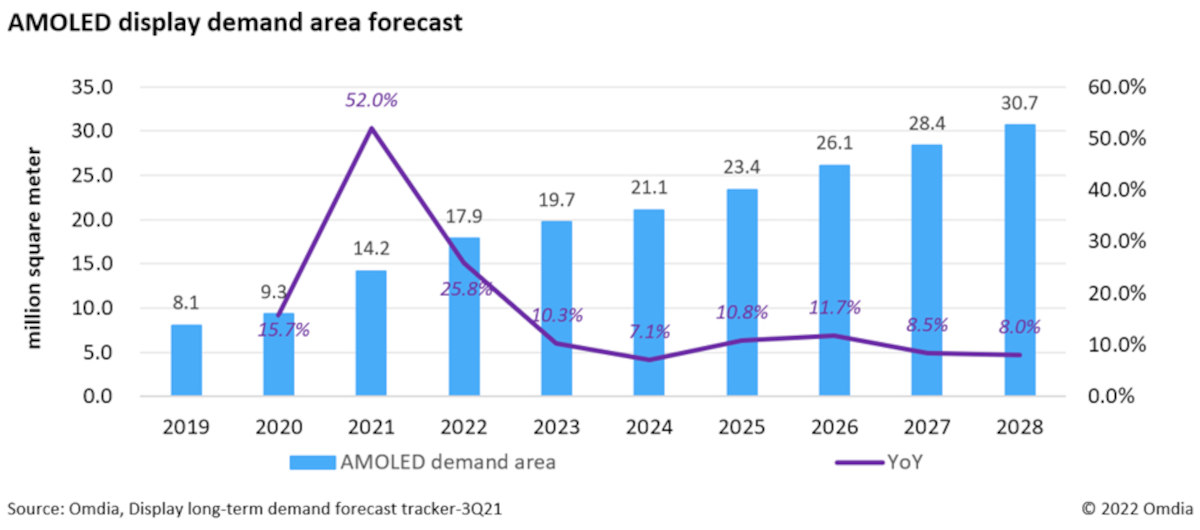
Omdia expects the OLED market to continue its strong growth, even though growth will be slower in the future. The demand for AMOLED display area will grow by CAGR of 11.6% from 2021 to 2028, to reach 30.7 million square meters.
New OLED gadget: Sony Bravia A75K
Sony's mid-range 2022 OLED TV, the A75K, sports 120hz 4K WOLED panels, at 55-inch and 65-inch in size. Other features include Sony's own Cognitive Processor XR, Android TV platform and two HDMI 2.1 ports with VRR support.

Sony did not reveal the price or release date of the A75K yet
On Sidtek's OLED microdisplays status and plans
China-based Semiconductor Integrated Display Technology, or SidTek, is an OLED microdisplay developer established in 2016. The company has recently started to produce OLED microdisplays on 8-inch silicon wafers, at its first production line located in the Chenhongda industrial park, in Wuhu, Anhui province, China.

Sidtek currently produces three display types in production
- 0.39" 1024x768 full-color
- 0.61" 800x600 or 1280x1024 full-color and monochrome
- 0.97" 1400x1050, monochrome
Inuru now offers printed OLED lighting panels in any shape on demand
OLED lighting developer Inuru announced that it is now capable to print OLED panels in any shape, on demand.

Inuru has setup a pilot line in Berlin Adlershof. The company says its new panels offers very small size, as required, and excellent homogeneity. The company can pair it with thin printed batteries to power the lighting panels.
TU/e leads a new research project to develop a strategy to suppress OLED exciton quenching
Eindhoven's Technical University (TU/e) announced a new project called SEQUOIA that aims to develop a strategy for the suppression of exciton quenching in OLED devices.
Exciton quenching, caused due to unwanted interactions among excitons and between excitons and charges, causes the efficiency of OLEDs to drop as brightness increases. The researchers hope to develop new materials and new OLED design to suppress (or hopefully eliminate entirely) this problem.
trinamiX says its under-the-OLED 3D sensor has been certified to top security standards
In 2021 we reported that Germany-based trinamiX (a subsidiary of BASF) developed an under-the-OLED 3D imaging sensor, that enables high performance face authentication while working behind the display.
The company now announced that its Face Authentication technology has been accredited according to the top standards as defined by Android and FIDO Alliance, which means that its solution now meets high security demands.
SDC launches a new platform for OLED material simulation to support its partners R&D projects
Samsung Display launched a new platform for OLED material simulation, to support its growing partner ecosystem for the development of OLED materials. The platform is open for Samsung's partners at no cost, and other companies can obtain a license.

The platform, called Sync-OLED, is used to evaluation OLED material characteristics before they are synthesized, to help speed up R&D projects that aim to find improved materials. The platform was developed in collaboration with the Korea Institute of Science and Technology Information (KISTI) Super Computing Application Center.
SDC's QD-OLED production yields still very low, waiting for market reaction for first wave of products
According to a report from Korea, Samsung's QD-OLED production yields are still very low (around 30%), and the company is currently waiting for market reaction of the first range of products.

The company will need to decide whether to expand its production in the near future or not, and according to the report, it is not likely to decide before the 2nd half of 2022, as products haven't actually been launched yet. This means that SDC's total QD-OLED capacity will remain as it is today (30,000 monthly Gen-8.5 panels) at least until the end of 2023.