The OLED-Info weekly newsletter
Published: Tue, 03/08/22



The OLED-Info newsletter (March 8, 2022)
Cannot read this? View it online here
New OLED gadget: Oppo Find X5 X5 Lite / X5 Pro
The Oppo Find X5 smartphone features a 6.55" 1080x2400 120Hz 1,000 nits AMOLED display, a Qualcomm Snapdragon 888 5G chipset, 8/12 GB of RAM, 128/256 GB of storage and a triple camera setup with two 50 MP sensors.

The Find X5 Pro offers an improved display - 6.7" inch, 1440x3216 120Hz 1,300 nits LTPO AMOLED, and increased performance and memory options. The Find X5 Lite has a 6.43" 1080x2400 90Hz 800 nits display and lower specifications.
The Oppo Find X5 is now shipping, starting at $1,285 in the US
(Dual SIM, international version).
UBI: 746 million AMOLED panels shipped in 2021, generating over $38 billion in revenue
UBI Research estimates that shipments of small-sizes (under 10-inch) AMOLED displays reached 746 million in 2021, up 34.4% from 2020 (555 million units). UBI says the market was driven by increased Apple iPhone sales and increased adoption of foldable OLED panels.
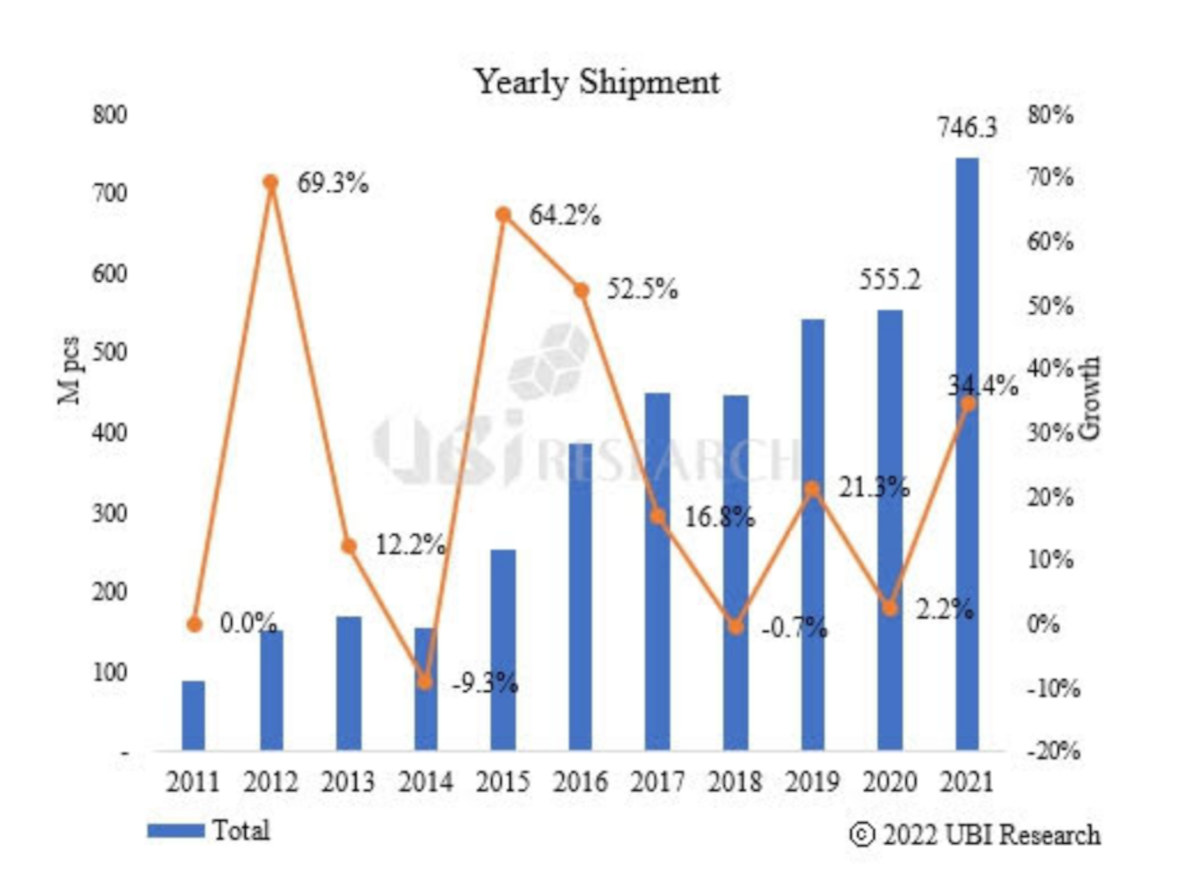
In terms of revenues, the market increased by 43.9% from $26.5 billion in 2020 to $38.1 billion in 2021.
Over 10 new OLED smartphones announced at MWC 2022
During the Mobile World Congress, many smartphones were announced (and some already released) that use AMOLED displays. Here's the current list of phones we added to the OLED phone database, although we're sure more phones will surface soon:
- Oppo Find X5 / X5 Lite / X5 Pro
- TCL 30/ 30+
- Xiaomi Poco M4 Pro / Poco X4 Pro
- ZTE Nubia Z40 Pro
- Honor Magic4 / Magic4 Pro
- Lenovo Legion Y90
- Oppo Reno7 Z 5G
- Xiaomi Redmi Note 11E Pro
Some of these phones use very advanced displays, for example the Honor Magic4 with its 6.81" 120Hz 1,000 nits 1224x2664 LTPO AMOLED display and the Lenovo Legion Y90 Y90 with a 6.92" 144Hz 1,300 nits 1080x2460 AMOLED.
DigitalTrends: the Sony A95K QD-OLED TV offers the best image quality ever
Earlier this year Sony announced the world's first QD-OLED TV, the A95K. The TV is not shipping yet, but the first reviews are in - and the ones we have seen say that the display quality of Sony's new TV (and Samsung's new OLED panels) is superb.

A reporter from DigitalTrends, Caleb Denison, for example, spent some hours in front of an A95K, and says that the display is bright (the brightest he has seen in a consumer TV) and it offers the most accurate colors he ever saw. The colors are pure and "better than any OLED, and most QLED TVs, too".
Samsung Display starts developing a tandem OLED for Apple's iPad
Back in 2020 we reported that Apple is worried about lifetime and burn-in issues in AMOLED displays in tablet applications, and Apple decided to adopt a tandem OLED architecture in the displays it will eventually adopt in future iPad devices.
LG Display already developed such panels for automotive applications, and according to reports it is developing a tandem LTPO AMOLED display for Apple, aiming to supply these to Apple at around 2024. According to a new report, Samsung Display has launched a project to develop tandem OLED panels as it also hopes to supply panels for Apple's future iPads.
New OLED gadget: Lenovo ThinkPad T14s G3
Lenovo's 2022 ThinkPad T14s G3 is a business laptop that features an optional 14" 2.8K 90Hz AMOLED display. The laptop is powered by a 12th Gen Intel Core i vPro or an AMD Ryzen Pro 6000 (19 W).

The ThinkPad T14s G3 starts at around $1,400 (AMD, LCD display) and will ship in May 2022.
On SEL's ExTET OLED device architecture
In 2016, Researchers from Japan's Semiconductor Energy Laboratory (SEL) announced a new OLED device architecture, called ExTET ('exciplex–triplet energy transfer'), that can increase the performance of OLED devices. The technology was applied for a patent in 2011.
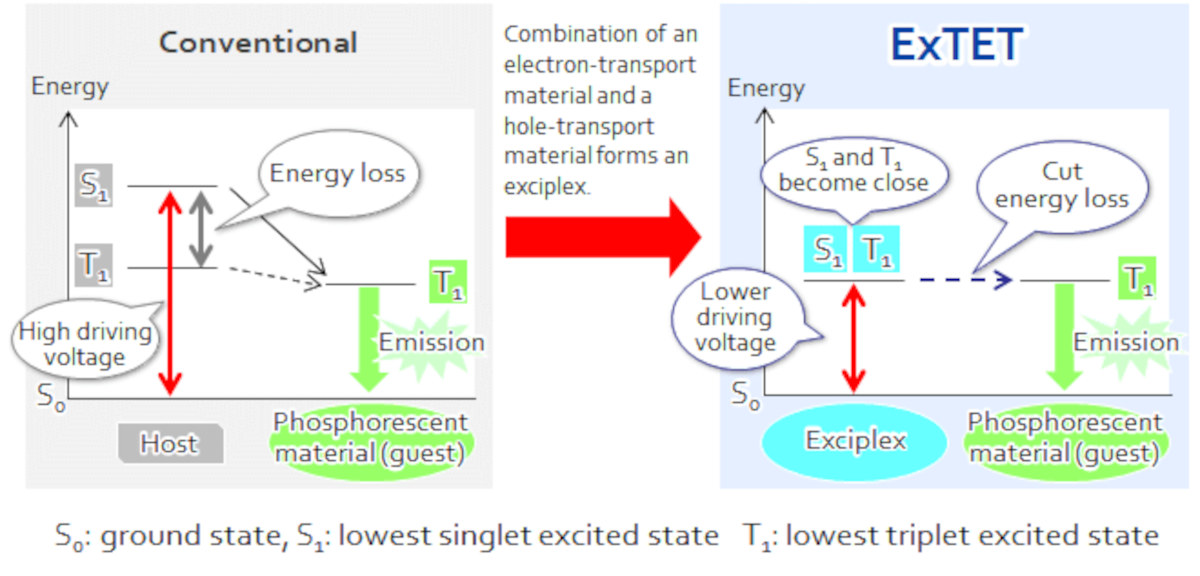
The ExTET technology, which is a modification of the host material and the EML layer in phosphorescent OLED devices, have since been introduced to commercial AMOLED panels, increasing the efficiency and lifetime of the materials, while also lowering the drive voltage.
OLED lighting for automotive application - early 2022 market snapshot
The OLED lighting market is still in its very early stages – as currently commercial shipments mostly consist of premium lamps and installations, and the industry target niche applications - such as commercial lighting, health-related solutions and the automotive industry.
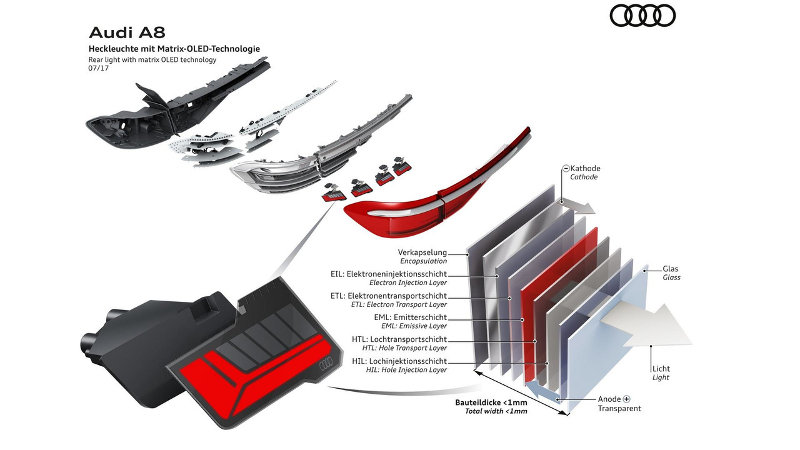
OLEDs offer several unique advantages to the automotive market , and it's also a market with defined premium cars that can be used for early adoption of high cost technology. In the past few years, we've seen several car makers (including Audi, Mercedes and BMW) that started to adopt OLED lighting in car taillights. Initial adoption was for optional modules, but today several car models come with OLED lighting as standard. OLED lighting can be used for several applications within the automotive market.
Simbeyond secures investment to revolutionize the R&D workflows
Simbeyond provides unprecedented software tools for the development of high-tech (nanotechnology-based) devices that replace a large part of the costly and time-consuming experimental R&D efforts with computer simulations. In other words, creating digital twins of physical prototypes.

The unique approach that Simbeyond provides allows customers to analyze, predict and improve device performance which benefits both device manufacturers looking to optimize OLED stacks and material manufacturers looking to screen new materials. The intuitive web interface of the Bumblebee software allows you to quickly prepare and specify your virtual experiment and start dozens of device or material simulations from your laptop using a cloud-based environment.
The Nintendo Switch OLED display only shows signs of burn-in after an extreme 3,600 hours test
A YouTube technology reviewer Bon Wulff has performed a five-months long test of its Nintendo Switch OLED console, trying to estimate the burn-in problem in the device's AMOLED display. He used a static image, running it for hours, checking for any visible burn-in issues.
It turns out that it took 3,600 hours of nonstop projection of the single image for the AMOLED to exhibit any visible burn-in problems. This is an extreme test, which is a great testament to the durability of modern AMOLED displays, and a great reassurance to all the consumers who are worried about OLED display burn-in.