The Graphene-Info newsletter, November 2019
Published: Mon, 11/04/19


Smart insole with graphene sensors may become a lifesaving technology for diabetic patients
Stevens Institute of Technology (SIT), a private, coeducational research university located in New Jersey, United States, has signed an exclusive licensing agreement with Bonbouton for the right to use and further develop a graphene sensing system that detects early signs of foot ulcers before they form so people living with diabetes can access preventative healthcare and confidently manage their health.

The smart insole can be inserted into a sneaker or dress shoe to passively monitor the foot health of a person living with diabetes. The data are then sent to a companion app which can be accessed by the patient and shared with their healthcare provider, who can determine if intervention or treatment is needed.
Bonbouton's smart insoles sense the skin's temperature, pressure and other foot health-related data, which can alert a patient and his or her healthcare provider when an infection is about to take hold. This simplifies patient self-monitoring and reduces the frequency of doctor visits, which can ultimately lead to a higher quality of life.


Graphene oxide proposed as a significant component of interstellar dust
Peter J Sarre, Professor of Chemistry and Molecular Astrophysics at the University of Nottingham in the UK, has released a fascinating work that infers, based on previously unassigned optical and infrared astronomical observations and comparison with laboratory data on graphene oxide (GO), that GO is a significant component of interstellar dust.

Dust particles play a major role in the formation, evolution and chemistry of interstellar clouds, stars, and planetary systems. Commonly identified forms include amorphous and crystalline carbon-rich particles and silicates. Also present in many astrophysical environments are polycyclic aromatic hydrocarbons (PAHs), detected through their infrared emission, and which are essentially small flakes of graphene.
Astronomical observations over the past four decades have revealed a widespread unassigned ‘extended red emission’ (ERE) feature which is attributed to luminescence of dust grains. Numerous potential carriers for ERE have been proposed but none has gained general acceptance. In this work it is shown that there is a strong similarity between laboratory optical emission spectra of graphene oxide (GO) and ERE, leading to this proposal that emission from GO nanoparticles is the origin of ERE and that these are a significant component of interstellar dust. The proposal is supported by infrared emission features detected by the Infrared Space Observatory (ISO) and the Spitzer Space Telescope.
Rice team designs graphene-based air filter that grabs and zaps pathogens
Rice University scientists under chemist James Tour have transformed their laser-induced graphene (LIG) into self-sterilizing filters that grab pathogens out of the air and kill them with small pulses of electricity. This may be of special interest to hospitals, where according to the Centers for Disease Control and Prevention, patients have a 1-in-31 chance of acquiring a potentially antibiotic-resistant infection during hospitalization.
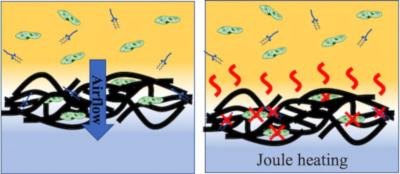
The device reportedly captures bacteria, fungi, spores, prions, endotoxins and other biological contaminants carried by droplets, aerosols and particulate matter. The filter then prevents the microbes and other contaminants from proliferating by periodically heating up to 350 degrees Celsius (662 degrees Fahrenheit), enough to obliterate pathogens and their toxic byproducts. The filter requires little power, and heats and cools within seconds.
GrapheneCA provides graphene for major commercial construction project in Mexico
GrapheneCA has reported that it is the sole provider for all of the graphene being used in a major commercial construction project that makes use of the material currently underway in Mexico.
In a statement, the privately-owned graphene supplier and manufacturer, said the new convention center, Centro de Convenciones Siglo XXI, which is being built 200 kilometers away from Cancún, relies on concrete enhanced by GrapheneCA’s 99.7% carbon pure graphene in its entirety.
The group pointed out that constructions that use graphene as an additive are anti-flammable, anti-corrosive, and share its improved mechanical properties, which makes graphene-based concrete ideal for wet constructions in high-humidity and storm-prone areas as well.
Cryorig launches graphene-enhanced cooling system for PCs
PC gear company Cryorig has introduced its low-profile CPU graphene-enhanced cooling system for small form-factor PCs that can dissipate up to 125 W. The Cryorig C7 G is among the smallest coolers for higher-end processors available today. To make C7 G's high performance possible, Cryorig applied graphene coating on the heatsink.
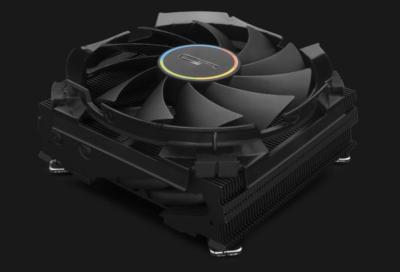
As demands arise for higher-performance components, cooling designers are creating low-profile coolers rated for TDP levels of 95 W of higher. To maximize efficiency of such devices, manufacturers use copper for heatsinks, many heat pipes, and large fans. Cryorig decided to go one step further and applied graphene coating to the radiator’s fins. Thermal conductivity of graphene is considerably higher than thermal conductivity of aluminum or copper, so applying it on the fins could theoretically improve cooling performance.
Cryorig’s C7 G cooler is set to be available in Japan starting September 28 for ¥9,960 without sales tax ($92.50), which is certainly higher than average for an air cooler. Evidently, the graphene coating is expensive and dissipating up to 125 W using a cooling system featuring a 47 mm z-height is a unique capability. The unit is already available on Amazon.
2D Fab collaborates with SAAB and Blackwing to develop graphene-enhanced components for the aviation industry
2D fab, together with SAAB and Blackwing Sweden, developed new graphene-enhanced components for the aviation industry that offer increased lightning strike protection and strength.
The project, called Multigraph, was launched in 2017 with the mission to create better components for the aviation industry. The aim was to use graphene’s multifunctional properties to increase the mechanical strength and electrical conductivity of the materials used, the latter reducing the amount of maintenance required due to lightning strikes.
Multigraph, partly financed by Vinnova, is a collaboration between 2D fab, SAAB, Blackwing Sweden, Chalmers and two Brazilian universities (UFABC and ITA). The results – presented October 10th at the Brazilian-Swedish workshop on aeronautics in Stockholm – can be considered a success: by adding graphene to the polymers used, electrical conductivity and strength both improved. 2D fab and SAAB have been granted renewed funding from Vinnova and will continue working toward better components for the aviation industry.
Graphene-Info's Batteries, Supercapacitors, Graphene Oxide, Lighting, Displays and Graphene Investments Market Reports updated to October 2019
Graphene-Info has published new versions of all its graphene market reports, which are now updated to October 2019.
Among these are: The Graphene Batteries Market Report, The Graphene Supercapacitors Market Report, The Graphene for the Display and Lighting Industries, The Graphene Oxide Market Report and The Graphene Investment Guide.
Read more about our graphene market reports, and download your own copy here. We offer affordable "hands-on" market reports that will quickly get you up to speed with the graphene industry and market.
Physicists at the University of Wisconsin-Milwaukee have been awarded a grant of over a $1 million from the U.S. Department of Energy to develop lithium-ion battery parts made from a unique, patented material called graphene monoxide which is said to dramatically boost the energy storage capacity of li-ion batteries.
Talga Resources has executed a Joint Development Agreement (JDA) with BillerudKorsnäs, a Swedish multinational packaging company, for development and commercialization of graphene-enhanced packaging products.
XG Sciencesand Terrafilum announced a joint development agreement to develop, produce and market 3D printing filaments and coatings using graphene-based materials.
The University of Nebraska Lincoln has partnered with the Department of Defense and received a $4.5 million, 3-year grant for graphene research.
Researchers at Valencia's Polytechnic University (UPV) have developed new devices that store electric charge in textile materials, which could be used to, for example, charge mobile phones.
Haydale has launched a range of graphene-enhanced prepreg materials for lightning-strike protection, utilizing functionalized graphene to improve the electrical conductivity.
Cardea Bio (formerly: Nanomedical Diagnostics) and Nanosens Innovations have joined forces to accelerate the development of the Genome Sensor: the world's first DNA search engine that runs on CRISPR-Chip technology.
A collaboration between three Australian universities has produced a new graphene metamaterial that could be used in solar heating. The ultrathin film also has potential to be used in desalination, for displays, or even as cloaking technology.
Talga Resources has announced that it has executed a Memorandum of Understanding with Switzerland-based Leclanché, a leading provider of high quality energy storage solutions.
A research team led by Graphene Flagship partners Consiglio Nazionale delle Ricerche (CNR), Italy, and Chalmers University of Technology, Sweden, together with a team at the University of Modena, Italy, has created a new qualitative graphene-based sensor for morphine, that could be used by police to detect opiate abuse using suspects' urine samples.
Tetra Pak has joined the Graphene Flagship project as the exclusive representative from the packaging industry to explore possible future applications of graphene in food and beverage manufacturing.
Researchers from Northwestern University have created 2D heterostructures from graphene and borophene, taking an important step toward creating intergrated circuits from these nanomaterials.
UK-based start-up company, GraphCase, has developed a patent-pending technology to create a composite polymer using graphene, which is made from 100% recycled plastics. A prototype for a graphene-based smart suitcase made from this material has been developed in collaboration with The University of Manchester.
Do you have a friend or a colleague that might be interested in Graphene technology? Forward this mail to update him on the world of Graphene.
If you received this email from a friend, subscribe to this newsletter here!


