The Graphene-Info newsletter, June 2019
Published: Mon, 06/03/19


Korean team designs graphene-based transparent flexible battery
Researchers at Daegu Gyeongbuk Institute of Science and Technology (DGIST) have developed film-type, graphene-based multi-functional transparent energy devices.
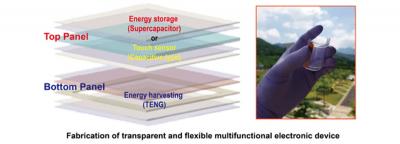
Senior researcher Changsoon Choi's team used single-layered graphene film as electrodes in order to develop transparent devices. By using a high-molecule nano-mat that contains a semisolid electrolyte, the research team increased transparency (maximum of 77.4%) to see landscape and letters clearly.
The research team designed a structure for self-charging electronic devices by inserting the energy storage panel inside the upper layer of power devices, and the energy conversion panel inside the lower panel. They also manufactured electronics with touch-sensing systems by adding a touch sensor right below the energy storage panel of the upper layer.


Researchers develop washable, wearable graphene capacitors that can be woven directly into clothes
Researchers at the University of Cambridge and Jiangnan University in China have developed graphene-enhanced wearable electronic components incorporated directly into fabrics. The devices could be used for flexible circuits, healthcare monitoring, energy conversion, and other applications.
The researchers have shown how graphene and other related materials can be directly incorporated into fabrics to produce charge storage elements such as capacitors, paving the way to textile-based power supplies which are washable, flexible and comfortable to wear. The research demonstrates that graphene inks can be used in textiles able to store electrical charge and release it when required. The new textile electronic devices are based on low-cost, sustainable and scalable dyeing of polyester fabric. The inks are produced by standard solution processing techniques.
Graphene oxide assists in purifying water without chlorination
Scientists from the National University of Science and Technology "MISIS" together with their colleagues from Derzhavin Tambov State University and Saratov Chernyshevsky State University have shown a way for graphene oxide to purify water, making it drinkable, without further chlorination. "Capturing" bacterial cells, it forms flakes that can be easily extracted from the water.
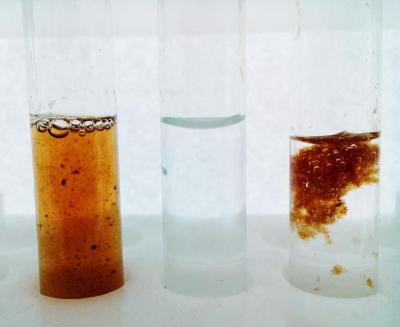
The team has conducted an experiment, injecting graphene oxide into solutions (nutrient medium and the saline) containing E.coli. Under the terms of the experiment, saline "simulated" water, and the nutrient medium simulated human body medium. The results showed that the graphene oxide along with the living and the destroyed bacteria form flakes inside the solutions. The resulting mass can be easily extracted, making water almost completely free of bacteria. If the extracted mass is then treated with ultrasound, the graphene can be separated and reused.
According to scientists, if such a purification system is used for water, it will be possible to avoid additional chlorination. There are other advantages: decontamination with graphene oxide has a low cost, in addition, this technology is easy to scale to the format of large urban wastewater treatment plants.
Researchers bind hydrogen to graphene in a super-fast reaction that also opens up a bandgap
Researchers from Göttingen (Germany) and Pasadena (USA) have produced an "atomic scale movie" showing how hydrogen atoms chemically bind to graphene in one of the fastest reactions ever studied. The team found that by adhering hydrogen atoms to graphene, a bandgap can be formed.
The research team bombarded graphene with hydrogen atoms. "The hydrogen atom behaved quite differently than we expected," says Alec Wodtke, head of the Department of Dynamics at Surfaces at the Max Planck Institute (MPI) for Biophysical Chemistry and professor at the Institute of Physical Chemistry at the University of Göttingen. "Instead of immediately flying away, the hydrogen atoms 'stick' briefly to the carbon atoms and then bounce off the surface. They form a transient chemical bond," Wodtke exclaims. Something else also surprised the scientists: The hydrogen atoms have a lot of energy before they hit the graphene, but not much left when they fly away. It seems that hydrogen atoms lose most of their energy on collision, but where it goes remained to be examined.
KAUST researchers have tailored the structure of graphene-oxide layers to mimic the shape of biological channels, creating ultra-thin membranes to rapidly separate chemical mixtures.
Rice University researchers have adapted laser-induced graphene (LIG) into small, metal-free devices that generate electricity.
A team of researchers from China has reported a novel strategy to 'stitch' together reduced graphene oxide (rGO) nanosheets into ultra-strong, tough, and highly conductive graphene films using only small amounts of cross-linker.
Versarien has updated that it is now fully operational at its new U.S office and laboratory facility in Houston, Texas, which is designed to act as a hub for the Company’s activities in North America.
Engineers at the University of Wollongong are collaborating with surgeons at the University of Texas at Dallas to develop graphene fibers that combine the electrical properties of an electrode with the mechanical properties of a suture.
Directa Plus and clothing group Alfredo Grassi have extended their exclusive relationship to develop graphene-enhanced clothing for up to a further three years. The two companies will focus on the use of graphene to enhance military outerwear as well as work-wear for organizations like the Italian police and fire services.
Thomas Swan announced a collaboration with nano-materials technology manufacturer Graphene Composites (GC) to provide the graphene solution in their GC Shield Armour products.
Do you have a friend or a colleague that might be interested in Graphene technology? Forward this mail to update him on the world of Graphene.
If you received this email from a friend, subscribe to this newsletter here!


