The Graphene-Info newsletter, August 2019
Published: Tue, 09/03/19


Samsung rumored to launch phone with graphene battery next year
Samsung may be in the race to develop a graphene-based alternative to lithium-ion batteries for its phones. Rumors are going around claiming that the Company hopes to have at least one phone with a graphene battery ready next year or by 2021.
The word is that these graphene-based batteries will be capable of a full charge in under a half-hour, but they still need to raise capacities while lowering costs. Samsung may be looking into battery alternatives following past problems with its Note 7 phones, when users started reporting overheating problems. Samsung tied the issues to a battery design flaw and recalled all the Note 7 phones on the market. That didn't seem to fix the problem, though, with the replacement devices also overheating. Samsung launched a second recall and stopped manufacturing the Note 7. Following the problems, Samsung changed its testing process for key mobile components and instituted an eight-point inspection process for batteries.


Aecom uses graphene by Versarien to 3D print an arch that may modernize transport networks
Global infrastructure services firm Aecom is reportedly developing one of the UK’s first 3D-printed commercial products made from graphene-reinforced polymer.

Aecom has produced a graphene arch using additive manufacturing techniques. It believes the method could reduce the time and cost of installing digital signalling systems and transform the digitization of transport networks. The 4.5-meter high, lightweight arch is being tested on outdoor track at Network Rail’s workforce development center in Bristol.
The company’s CNCTArch is designed to drive down the costs associated with installing digital signalling systems on transport networks. Using a graphene arch that sits over rail tracks eliminates the need to attach new digital equipment to existing infrastructure. The CNCTArch can be used in both tunnels and open environments and has the potential to transform the deployment of digital traffic management systems, Aecom believes.
Will graphene oxide be the answer to mosquito bites?
A new study by Brown University shows that graphene sheets can block the signals mosquitoes use to identify a potential blood 'donor', which may enable a new chemical-free approach to mosquito bite prevention.
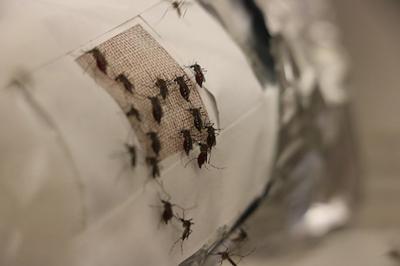
The researchers showed that multilayer graphene can provide a two-fold defense against mosquito bites. The ultra-thin yet strong material acts as a barrier that mosquitoes are unable to bite through. At the same time, experiments showed that graphene also blocks chemical signals mosquitoes use to sense that a blood meal is near, blunting their urge to bite in the first place. The findings suggest that clothing with a graphene lining could be an effective mosquito barrier, the researchers say.
Skeleton Technologies' graphene-based supercapacitors to power Škoda trams in Mannheim
Skeleton Technologies, European developer of graphene-based supercapacitors and energy storage systems for transportation and grid applications, will supply supercapacitor systems to Škoda Electric, a traction equipment manufacturer, for 114 trams to be delivered by Škoda Transportation to Mannheim, Heidelberg, and Ludwigshafen in Germany.
The system recuperates the braking energy of the trams and uses it for re-acceleration, saving energy and decreasing costs. Supercapacitors are ideal for this application due to their high efficiency, reliability, and ability to recharge in seconds.
New laser printing method rapidly and efficiently yields textiles embedded with graphene supercapacitors
Scientists from RMIT University in Melbourne, Australia, have developed a cost-efficient and scaleable method for rapidly fabricating textiles that are embedded with energy storage devices. The team reports that in just three minutes, the method can produce a 10x10cm smart textile patch that's waterproof, stretchable and readily integrated with energy technologies like graphene supercapacitors, laser printed directly onto the textiles.
As a proof-of-concept, the researchers connected the supercapacitor with a solar cell, delivering an efficient, washable and self-powering smart fabric that overcomes the key drawbacks of existing e-textile energy storage technologies. The research analyzed the performance of the proof-of-concept smart textile across a range of mechanical, temperature and washability tests and found it remained stable and efficient.
Chinese researchers developed a new type of graphene porous fibers decorated with nanoballs and high gauge factors to improve the sensitivity of wearable sensors.
Researchers from Stanford, NIST, Theiss Research and several others designed a new heat protector that consists of just a few layers of atomically thin materials, to protect electronics from excess heat.
A team of researchers from the Physics, Medicine and Chemistry departments at Heinrich Heine University Düsseldorf (HHU) examined if graphene nanoparticles are potentially dangerous for the organism and how cells cope with them once they have been incorporated.
University of California Santa Barbara (UCSB) engineering researchers recently came out with a method to utilize nanometer-scale doped multilayer graphene (DMG) interconnects suited to the mass-production of integrated circuits.
First Graphene has announced that, together with Steel Blue, it has manufactured prototype sets of safety boots incorporating PureGRAPH10.
Riptron, a spin-out company from the University of Manchester, has entered a partnership with China-based Tunghsu Optoelectronics to advance graphene sensors designed to measure the quality of air.
Israel's Bar Ilan University (BIU) will establish a nanotechnology excellence center in collaboration with the Chinese Academy of Sciences (CAS).
Researchers from Bar-Ilan University in Israel and Yale University in the U.S reported on a novel device architecture comprising graphene Schottky diode varactors. The team assessed that such devices have great potential for optoelectronics applications.
Researchers at Daegu Gyeongbuk Institute of Science and Technology (DGIST) developed a graphene-based technology that can obtain high-resolution, micrometer-sized images for mass spectrometric analysis without sample preparation.
STANDARD GRAPHENE, a flake graphene producer headquartered in South Korea, recently announced the establishment of a water filtration plant at Lumbini, Nepal.
Do you have a friend or a colleague that might be interested in Graphene technology? Forward this mail to update him on the world of Graphene.
If you received this email from a friend, subscribe to this newsletter here!


