The Graphene-Info newsletter, June 2017
Published: Mon, 07/03/17


Talga Resources reports positive test results on graphene Li-ion batteries
Talga Resources provided an update on initial benchmark testing of its graphene in Lithium-ion batteries, manufactured at the Warwick Manufacturing Group’s Energy Innovation Center, University of Warwick UK. Following successful tests of the Company’s micrographite product, Talga announced its intention to move towards testing its graphene nanoplatelets (GNPs) as the active material of Li-ion battery anodes.
Talga also announced a funding initiative to raise gross proceeds of $12.3 million AUD (around $9.2 million USD). The Placement was made to a small group of targeted institutions and was also strongly supported by a group of Talga’s major shareholders.


Skeleton uses curved graphene in its new supercapacitor-based energy storage system
Skeleton Technologies launched SkelGrid, an energy storage system for industrial power applications, based on the company's curved graphene supercapacitor technology. The system is meant to ensure reliable power quality in manufacturing plants, data centers, and more.
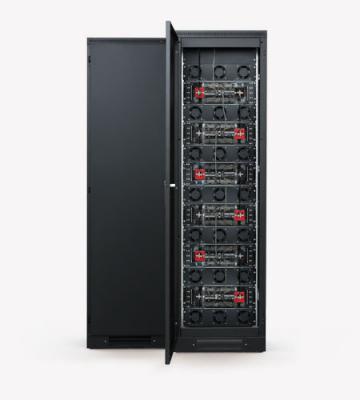
SkelGrid is said to provide the highest power and energy density on the market in the industry standard electrical cabinet or container format. The SkelGrid product family is based on SkelRack modules, which can be installed in industry standard 19”, 600mm deep cabinets, and in 20 or 40 ft. containers to provide short-term power at the megawatt level. The SkelGrid family has maximum power ratings ranging from 520 kW up to 1500 kW, and as a modular product, its components can be configured according to customers’ needs.
ORA launches a highly successful crowdfunding campaign for its graphene-enhanced headphones
ORA, Canada-based developer of graphene-enhanced audio equipment, launched a Kickstarter crowd-funding campaign for graphene-enhanced wireless Bluetooth earphones that promise comfort, high fidelity and long battery life. The crowdfunding campaign has since been doing extremely well and (at the time of writing this post) has already tripled its mark!

The product is regarded as the first commercial audio product to use graphene, and is now available at the "early bird" price of $199 (retail price should be $499). The ORA Headphones feature GrapheneQ membranes for excellent tonality and superior dampening, high efficiency drivers for extended battery life, touchpad controls to skip songs, control volume and answer calls, high quality built-in microphone for hands-free calling, and ear-shaped design optimized for fit and ergonomics.
Graphene-based Audio applications are a popular area of research focus. The earliest research we covered was in 2011 when researchers from Korea developed a transparent speaker made from Graphene. In 2013 graphene-based speaker that can outperform the best commercially-available earphones was demonstrated. Recently several companies have also released graphene-enhanced earphones, like the aforementioned Xiaomi and Fiio. In addition, Israeli audio pioneer Waves Audio is developing an innovative electrostatic speaker using a nanoscale active membrane based on graphene.
Graphene-based transistor to potentially make ultra-fast computers
Researchers at the University of Central Florida, the University of Texas at Dallas and other collaborators have designed a graphene-based transistor which could be used to create an all-carbon spin logic design with the potential to someday lead to computers that are a thousand times faster and use a hundredth of the power.
The design is based on graphene nanoribbons and carbon nanotubes, which in conjunction can be used to create cascaded logic gates that are not physically linked. The communication between the gates happens via an electromagnetic wave (and does not use any physical movement of electrons), it is anticipated that communication will be much quicker - with the potential for terahertz clock speeds. The size of these logic gates will be much smaller than silicon based gates.
Chinese company develops clothes made of unique graphene fibers
A Chinese company called Shanghai Kyorene New Material Technology has reportedly developed a graphene fiber, that has been used to produce clothes, sports wear and underwear products. One company that states it uses these fibers in actual commercial products is Armor Guys, a U.S-based glove maker.
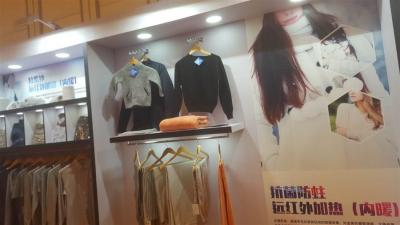
The technology is said to make graphene completely integrated with high polymer materials under room temperature, and adds special function to ordinary textile products like antibacterial, ultraviolet-proof, anti-static and heat preservation effects.
Scientists use lasers to 3D print graphene foams
Researchers at Rice University and China's Tianjin University have used 3D laser printing to fabricate centimeter-sized graphene objects. The team has demonstrated the making of graphene foams from non-graphene starting materials, in a method that could reportedly be scaled for additive manufacturing applications with pore-size control. The process is conducted at room temperature, without the need for molds. The rather unusual starting materials are powdered sugar and nickel powder.
The new Rice process used a commercially available CO2 laser. When this laser was directed at the sugar and nickel powder, the sugar was melted and the nickel acted as a catalyst. Graphene formed as the mixture cooled after the laser had moved on to melt sugar in the next spot, and the team conducted a study to find the optimal amount of time and laser power to maximize graphene production. The foam created by the process is a low-density, 3D form of graphene with large pores that account for more than 99% of its volume.
Chinese team uses graphene oxide to create moisture-responsive spider robots
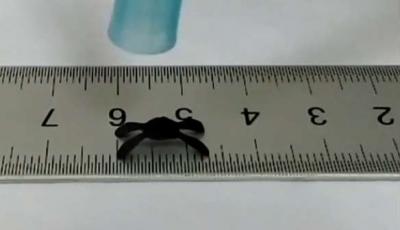
Researchers from China have turned a sheet of graphene oxide into a material that bends when exposed to moisture, which they used to create a spider-like crawler and claw robot that move in response to changing humidity conditions without the need for any external power.
The researchers stated that "Our very simple method for making typical graphene oxides smart is also extremely efficient. A sheet can be prepared within one second". They also reported that graphene oxide sheets treated with brief exposure to bright light in the form of a camera flash exhibited reversible bending at angles from zero to 85 degrees in response to switching the relative humidity between 33 and 86 percent. They also demonstrated that their method is repeatable and the simple robots they created have good stability.
To make a moisture-driven crawler, the researchers cut flash-treated graphene oxide into an insect shape with four legs. The free-standing crawler was about 1 centimeter wide and moved forward when humidity was increased. Switching the humidity off and on several times induced the crawler to move 3.5 millimeters in 12 seconds, with no external energy supply. The researchers also made a claw shape by sticking together eight 5-by-1 millimeter ribbons of flash-treated graphene oxide in a star shape. When moisture was present, the claw closed within 12 seconds. It returned back to an open position after 56 seconds of exposure to dry air.
Researchers at Swinburne University are progressing towards producing commercially viable graphene oxide-based supercapacitors offering high performance and low-cost energy storage.
Graphene 3D Lab announced the launch of a new graphene-enhanced 3D printing filament - the Graphene-HIPS.
Imagine Intelligent Materials announced a commercial installation of its imgne X3 solution, at a Queensland coal seam gas site, reportedly completed during the 2nd week of May.
Exeter researchers recently reported a new method to use graphene to produce photodetectors, which they feel could revolutionize the manufacturing of vital safety equipment, such as radiation and smoke detection units.
Researchers at the Indian Institute of Science Education and Research (IISER) Pune have used graphene oxide to develop a novel cancer drug delivery system.
Guiness World Records named a 3D printed graphene aerogel as the least dense 3D printed structure. The material was developed by a Kansas State University, University at Buffalo and Lanzhou University (China) team, and weighs 0.5 milligrams per cubic centimeter.
Researchers from MIT fabricated a functional and efficient dialysis membrane from a sheet of graphene.
Researchers at Zhejiang University in China have designed a graphene-based aerogel mimicking the structure of the "powdery alligator-flag" plant that could have potential for use in applications like flexible electronics.
Directa Plus teamed up with clothing manufacturer Alfredo Grassi to develop graphene-enhanced clothing, workwear, uniforms and more.
Researchers affiliated with UNIST (Ulsan National Institute of Science and Technology) in Korea have engineered a new type of carbon nanomaterials, reportedly capable of changing shapes and colors depending on the type of solvents used.
Group NanoXplore announced that it will merge with Graniz Modal, a public company that trades in the Canadian stock exchange. Effectively, NanoXplore will become a public company.
Saint Jean Carbon announced that it closed its latest financing round - raising $667,500
Do you have a friend or a colleague that might be interested in Graphene technology? Forward this mail to update him on the world of Graphene.
If you received this email from a friend, subscribe to this newsletter here!


