The Graphene-Info newsletter, October 2017
Published: Tue, 10/03/17


Honey can be used as a cheap and safe material for graphene manipulation
Researchers at the Space and Naval Warfare Systems Center Pacific (SSC Pacific) revealed that honey can serve as an effective, non-toxic substitute for the manipulation of the current and voltage characteristics of graphene. The researchers were investigating various dielectric materials they could use to fabricate a graphene transistor; After several unsuccessful attempts, they tested honey, and made an unexpected scientific discovery.
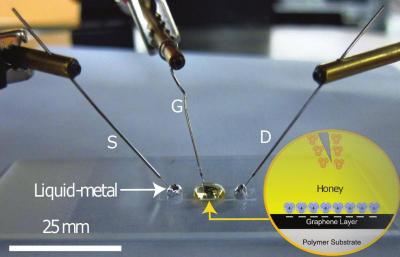
The team describes how honey produces a nanometer-sized electric double layer at the interface with graphene that can be used to gate the ambipolar transport of graphene. "As a top-gate dielectric, water is much too conductive, so we moved to sugar and de-ionized water to control the ionic composition in hopes we could reduce conductivity," the team explained. "However, sugar water didn't work for us either because, as a gate-dielectric, there was still too much leakage current..... We decided to drop-cast honey on graphene to act as top-gate dielectric— I thought maybe the honey would mimic dielectric gels I read about in literature. To our surprise—everyone said it's not going to work—we tried and it did".
The team from SSC Pacific, in collaboration with the University of Hawai′i at Mānoa, have been developing novel graphene devices as part of a Navy Innovative Science and Engineering (NISE)-funded effort to imbue the Navy with inexpensive, lightweight, flexible graphene-based devices that can be used as next-generation sensors and wearable devices.


Talga Resources’ CEO shares his vision with Graphene-Info
Australia-based technology minerals company, Talga Resources, is actively developing graphene materials and graphene-based applications across many areas, including coatings, batteries, construction materials, composites and more.
Mark Thompson, Talga's managing director, kindly agreed to update us on Talga's graphene program and answer a few questions we had. Read the fascinating interview here.
Ionic Industries announces a process for economically mass-producing graphene micro supercapacitors
Ionic Industries announced a process for economically mass-producing graphene micro supercapacitors and added that its directors and key personnel have taken direct stakes in the company.
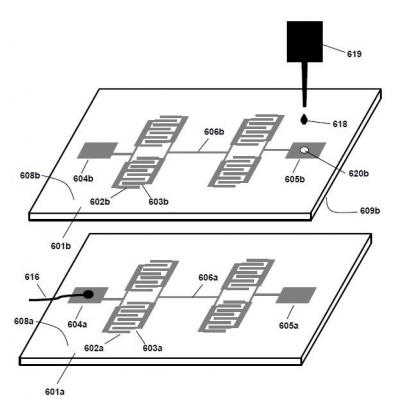
The last 2 years of work reportedly culminated in the filing of a new patent titled: Capacitive energy storage device and method of producing same (Australian Provisional Patent Application 2017903619). The new patent covers: the design of new energy storage device, being a planar micro supercapacitor printed on a porous film; Ionic's technique of stacking multiple layers of planar supercapacitors to create a 3D device that has ground-breaking energy and power density characteristics; and, most importantly, the company's method for printing these devices so that they can be mass produced at low cost
The critical element in this new technology is the ability to print the supercapacitors in the 1000s per minute, rather than individually creating each device with an expensive, direct-write approaches using lasers or ion beams. The technology builds on Ionic's existing patent relating to graphene oxide membranes and it means the company could create these devices as easily as factories today produce food packaging and labels using gravure printers.
Graphene-wrapped nanocrystals may open door toward next-gen fuel cells
Researchers at the Department of Energy’s Lawrence Berkeley National Laboratory have developed a mix of metal nanocrystals wrapped in graphene that may open the door to the creation of a new type of fuel cell by enabling enhanced hydrogen storage properties.
The team studied how graphene can be used as both selective shielding, as well as a performance increasing factor in terms of hydrogen storage. The study drew upon a range of lab expertise and capabilities to synthesize and coat the magnesium crystals, which measure only 3-4 nanometers (billionths of a meter) across; study their nanoscale chemical composition with X-rays; and develop computer simulations and supporting theories to better understand how the crystals and their carbon coating function together.
Reduced graphene oxide (or rGO) has nanoscale holes that permit hydrogen to pass through while keeping larger molecules away. This carbon wrapping was intended to prevent the magnesium – which is used as a hydrogen storage material – from reacting with its environment, including oxygen, water vapor and carbon dioxide. Such exposures could produce a thick coating of oxidation that would prevent the incoming hydrogen from accessing the magnesium surfaces. The study, however, suggests that an atomically thin layer of oxidation did form on the crystals during their preparation. Surprisingly, this oxide layer doesn’t seem to degrade the material’s performance.
China-based Tunghsu Optoelectronics unveils new graphene LEDs
The China-based Tunghsu Optoelectronic Technology announced a new series of graphene LED ‘super lights’ at the 2017 International Graphene Innovation Conference. The new lights reportedly use graphene for heat dissipation and conduction.
The new LEDs' volume is said to be 75% lower than traditional LED lights and they are 30% lighter. Power-saving capacity is 20-30% better and they provide high-performance luminescence and light distribution. The lights also come with a smart connection function, according to the company. Users can integrate information devices, transmit Wi-Fi hotspots, gather environmental information, monitor road security and act as emergency alarms.
Graphene-based water filtration project progresses and receives funding boost
The Smart Filter project received new Innovate UK funding that follows a previous £700,000 project grant awarded in 2015. The previous grant enabled a two-year project by G2O and the Centre for Process Innovation (CPI), focused on transferring and scaling up the water filtration technology from laboratory to industry, ensuring the technology is usable with full quality control.
The technology has since been validated at CPI and the new grant will focus on transferring it to large-scale manufacturing. That will include the use of industrial printing technology to manufacture membranes and validate their performance using prototypes and will involve collaboration with a number of UK partner organizations including chemicals manufacturer William Blythe and CPI. The ultimate aim of the project is to develop domestic water purification systems that will deliver cheaper and more widely-available drinking water to millions of people around the world.
Haydale has announced the first commercial sales of its products to Everpower Sheng Tie (Xiamen) Graphene Technology ("Everpower").
A team of researchers led by the Massachusetts Institute of Technology and Raytheon BBN Technologies developed a new graphene-enhanced device that can detect single photons across a wide range of the electromagnetic spectrum.
The National Science Foundation recently awarded University of Wisconsin-Milwaukee scientists $1.5 million to perfect a method of mass-producing graphene-based small water sensors using inkjet printing.
Researchers from CNR-Istituto Nanoscienze, Italy and the University of Cambridge, UK, associated with the Graphene Flagship, have shown that it is possible to create a terahertz saturable absorber using graphene, produced by liquid phase exfoliation and deposited by transfer coating and ink jet printing.
Researchers at the Institute for Basic Science (IBS) managed to observe the movement of molecules stored inside a graphene pocket without the need to stain them.
The advanced materials engineering group Versarien announced that it has won a tender for the ongoing supply of nanomaterials to the Centre for Process Innovation.
An international group of researchers, including scientists from Shinshu University in Japan and Penn State’s ATOMIC Center, created a graphene and graphene oxide-based coating for desalination membranes which are said to be more scalable and sturdier than current nanofiltration membrane technologies available.
The European Commission awarded nearly €3.7 million ($4.4 million USD) to an international initiative in the field of early diagnosis of brain cancer. The four-year program will focus on gliomas with specific objectives to identify new blood biomarkers for the disease, design plasmonic-based, graphene-based, and digital ELISA assay-based multiplex biosensors.
Do you have a friend or a colleague that might be interested in Graphene technology? Forward this mail to update him on the world of Graphene.
If you received this email from a friend, subscribe to this newsletter here!


