The Graphene-Info newsletter, August 2017
Published: Tue, 09/05/17


Tata Steel to put first graphene product on the market
Tata Steel's first graphene-based product is in the market - the company has announced the launch of ready-made graphene-coated stirrups, named Tiscon Superlinks+. Tata Steel's vice-president (steel & marketing), said when four columns are built, the support link is normally supplied by a local mason, which is made of steel. "But, it usually rusts. We have changed that by coating it with graphene."
Superlink+ reportedly has enhanced corrosion resistance and better bonding strength than other stirrups in the market. Tata Steel has filed seven patent applications in this area of work.


MIT team creates flexible, transparent solar cells with graphene electrodes
Researchers at the Massachusetts Institute of Technology (MIT) have developed flexible and transparent graphene-based solar cells, which can be mounted on various surfaces ranging from glass to plastic to paper and tape. The graphene devices exhibited optical transmittance of 61% across the whole visible regime and up to 69% at 550 nanometers. The power conversion efficiency of the graphene solar cells ranged from 2.8% to 4.1%.
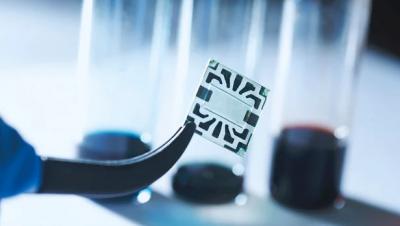
A common challenge in making transparent solar cells with graphene is getting the two electrodes to stick together and to the substrate, as well as ensuring that electrons only flow out of one of the graphene layers. Using heat or glue can damage the material and reduce its conductivity, so the MIT team developed a new technique to tackle this issue. Rather than applying an adhesive between the graphene and the substrate, they sprayed a thin layer of ethylene-vinyl acetate (EVA) over the top, sticking them together like tape instead of glue.
The MIT team compared their graphene electrode solar cells against others made from standard materials like aluminum and indium tin oxide (ITO), built on rigid glass and flexible substrates. The power conversion efficiency (PCE) of the graphene solar cells was far lower than regular solar panels, but much better than previous transparent solar cells. This is a positive advancement, obviously.
Manchester U team prints flexible GO-based supercapacitors on fabrics
Researchers from The University of Manchester recently demonstrated a flexible graphene-based supercapacitors printed directly onto textiles using a simple screen-printing technique.
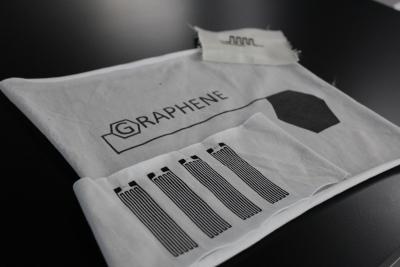
The solid-state flexible supercapacitor device has been demonstrated by using conductive graphene-oxide ink to print onto cotton fabric. The printed electrodes reportedly exhibited excellent mechanical stability due to the strong interaction between the ink and textile substrate.
Carbonated water can help in extracting graphene from its substrate
Researchers at the University of Illinois at Urbana-Champaign have discovered a new use for soda water - they designed a cleaner and more environmentally friendly method to isolate graphene using carbon dioxide (CO2) in the form of carbonic acid as the electrolyte solution.
Graphene is often synthesized by using chemical vapor deposition onto a metal substrate, typically copper foil. The issue of separating it from the metal substrate can be extremely tricky. This typically involves either dissolving away the high-purity metal or delaminating it from the substrate - which require the use of harsh chemicals that leave stubborn residue. “In our case, we are using a bio-mass derived polymer, ethyl cellulose, for the coating,” said a lead researcher on the project. “A common and inexpensive polymer often used as a food additive, ethyl cellulose is solvated in just ethanol. This not only makes our graphene transfer process more environmentally friendly, it is now also compatible with a variety of polymeric and soft biological materials such as common plastics and hydrogels that would otherwise not tolerate harsh solvents.”
The team believes this method can have an impact on not just the production of graphene, but also provide a green and affordable technique to use for etching and delamination processing of other materials as well.
Metalgrass launches a new knowledge hub to focus on Micro-LED displays
Graphene-Info has announced a new Metalgrass knowledge hub, MicroLED-Info.com. This new site will focus on Micro-LED display technology and its future market. MicroLED is quickly becoming a promising future display technology.
MicroLED-Info will bring you daily news, commentary, resources and updates about Micro-LED display technologies.
Nanomedical Diagnostics recently announced the launch of the new graphene-enhanced NHS Agile biosensor chip.
A collaboration work by Purdue, the Chinese Lanzhou University and Harbin Institute of Technology, and the U.S. Air Force Research Laboratory has yielded a lightweight, flame-resistant and super-elastic composite
Researchers at Purdue University have created a new type of graphene-enhanced non-liquid lubricant which reduces friction and wear. The suggested applications include air compressors for missile systems and more.
Researchers at Clemson University in the U.S have designed a prototype Aluminum-ion battery (AIB) that uses a graphene electrode to intercalate tetrachloroaluminate (AlCl4–).
Shanxi Leqi Graphene Technology, a Chinese company working on graphene applications, announced a new graphene-based batteries project.
Imagine IM, developer of graphene-based smart materials, was one of the three companies that were awarded US$80,000 grants for research and development projects targeting safer and smarter Australian roads by Transurban (manager and developer of urban toll road networks in Australia and the U.S).
Researchers at the U.S. Department of Energy’s Ames Laboratory successfully manipulated the electronic structure of graphene, which may enable the fabrication of graphene transistors that could be faster and more reliable than existing silicon-based transistors.
Haydale recently announced the launch of its Taiwan operations, Haydale Technologies Taiwan ('HTW'), which will operate as a dedicated producer and sales outlet of graphene-based conductive inks and pastes, including other functional and specialty inks and pastes.
Researchers from Korea and China have developed a method to synthesize large sheets of monolayer single-crystal graphene.
A collaborative project between Oxford Instrument, the National Physical Laboratory (NPL) and the National Graphene Institute (NGI) at University of Manchester for a turnkey quantum Hall system for graphene characterization and primary resistance metrology has been successfully completed.
Do you have a friend or a colleague that might be interested in Graphene technology? Forward this mail to update him on the world of Graphene.
If you received this email from a friend, subscribe to this newsletter here!


