Sony introduced its next-generation microLED display technology (direct-view LED as the company calls it), the high contrast Crystal LED C-series (ZRD-C12A/C15A) and the high brightness B-series (ZRD-B12A/B15A).
The new display modules offer two pixel pitch sizes (in both series), 1.26 mm and 1.56 mm and are equipped with Sony's "X1 for Crystal LED" image quality processor, which features Sony's signal processing technology and microLED control technology. Other features include high-quality and high-resolution upscaling, Sony's Motionflow technology for smooth and artifact-free pictures without motion blur, 22 bit Super Bit Mapping, 120 fps (HFR) and HDR.
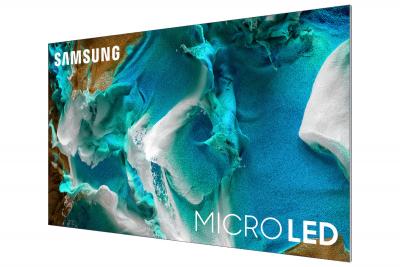
Towards the end of 2021, Samsung announced it's first "consumer"110-inch 4K MicroLED TV. It's not really for regular consumers with a price tag of around $150,000 - but this is a step forward in Samsung's goal to advance its MicroLED display technology.
Samsung now announced that its Micro-LED TVs will also be available in 99-inch sizes - and even smaller ones by the end of the year.
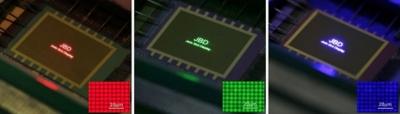
US-based Microdisplay developer Kopin announced an agreement with Jade Bird Display (JBD) to develop superbright monochrome microLED microdisplays. Kopin says that LED technology has the potential to enable super-high brightness and low power consumption displays.
Under this new agreement, JBD will provide LED wafers and hybrid bonding service to Kopin who will used its own silicon backplanes to produce monochrome 2kx2k 1" microdisplays.
In 2020 Taiwan's LED developers Epistar and Lextar announced plans to establish a joint holding company, effectively merging the two companies. Last week the company, called Ennostar Incorporation was formally launched.
Ennostar will focus on rapid development of mini-LED and micro-LED technologies and displays. The company has three main areas, divided between its daughter companies: Epistar will focus on LED epitaxy and chip, Lextar will focus on packaging and module, and Unikorn Semiconductor Corp. (under Epistar) will develop advanced compound semiconductor foundry.
In September 2020 LG launched its MAGNIT MicroLED TV. The company is now showcasing its next-generation TV technology at virtual CES 2021:
The MAGNIT TVs are made from 160x180 modules, arranged in 8-unit Cabinets (640x360 each). The MAGNIT offers a brightness of 600 nits (peak 1,200 nits) and feature LG's AI solution (based on its a7 image processor). LG says it uses a new advanced black coating technology that maximizes black levels and increase resistance to dust, humidly and finger marks. A 4K MAGNIT configuration is 163" in size.
Micro-LED and mini-LED developer Rohinni said that it developed a new placement technology for mini-LED that doubles the placement speed compared to its previous technology.
Rohinni developed a new bondhead which achieves a 100 Hz placement operation which effectively cuts in half the cost of placing mini LEDs. The technology will be deployed in the first part of 2021.
In 2020 China-based LED display maker Leyard Opto-Electronic launched its first microLED display modules, that can be used to create seamless large-area microLED displays. Now we hear that Chinese conglomerate CHN Energy Investment has installed the world's largest microLED display using Leyard's displays.
This display, produced and installed by Leyard, is 216 sqm in size, and has close to 250 million pixels - or over 7 times 8K resolution. The display was installed at CHN Energy's new Command and Control center.
Vuzix revealed that it has entered into a multi-year agreement with JBD (Jade Bird Display) to collaborate on the co-development and cross-supply of solutions incorporating microLED display engines and Vuzix waveguides. Under the agreement, JBD will provide microLED displays and Vuzix will provide newly developed proprietary waveguides and display engine optics to work with these displays.