MicroLED-Info weekly newsletter

Published: Tue, 07/14/20

MicroLED-Info logo  

The MicroLED handbook

ALLOS Semiconductor sells its HPE and RF business, to focus on the microLED market
2020-07-10 13:20:41-04

German-based GaN-on-Si developer ALLOS announced that it has shold its high-power electronics and RF business to AZUR SPACE. ALLOS will now focus its business on the microLED display market.

ALLOS Semiconductors developed its GaN-on-Si epiwafer technology for both high power electronics and Micro LED applications, but the time has come to focus on one market. The company says its 200 and 300 mm epiwafer technology is crucial in meeting the uniformity, crystal quality and manufacturability requirements of the novel Micro LED display applications.


Read more


Researchers develop a new method to transfer and bond microLED arrays on flexible plastic substrates
2020-07-11 02:27:53-04

Researchers from the University of Waterloo in Canada developed a new transfer and bonding method to deposit a flexible microLED array on plastic substrates.

Flexible microLED paste-and-cut technique schema, University of Waterloo

The technique, referred to as a "paste-and-cut", starts with bonding the LEDs on a process/handle wafer are temporarily bonded (pasted) onto a glass substrate and are then released (cut) to the flexible substrate. This approach allows the LED to be optimized and then combined with other materials.


Read more


Samsung faces technical issues and will have to delay the launch of its true microLED TVs
2020-07-12 03:33:58-04

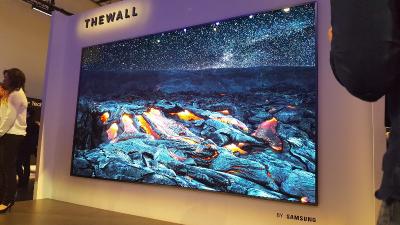
According to reports early in 2020, Samsung Electronics partnered with Epistar and PlayNitride that will enable Samsung to release its first true microLED TVs by the end of 2020. A new report from Korea suggests that Samsung is struggling with technology issues and it is not likely it will meet its goal of a product release in 2020.

Samsung 146'' micro-LED TV, The Wall

The reports suggest that production yields are very low - apparently Epistar is not able to provide Samsung with the millions of microLEDs required to produce its TVs. Another major issues is Samsung's transfer process which is still not accurate enough - with the result being that display assembly yields are painfully low.


Read more


Sponsored by:
 
MicroLED-Info | MicroLED introduction | OLED displays