Conclusion
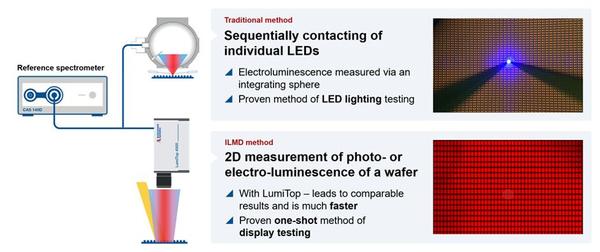
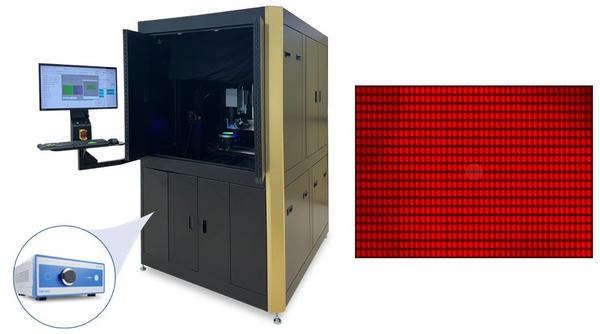
By combining high-resolution cameras, spectroradiometers, and live calibration, the proposed method dramatically reduces testing time. In the case of µLED wafers testing times go down from hours to few minutes while maintaining high accuracy. It is a powerful solution for industrial µLED metrology, essential for scaling µLEDs into mass production
of displays.
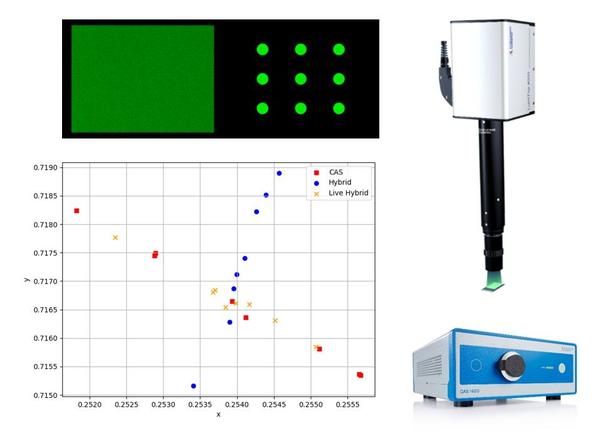
Calibration choice critically affects chromaticity accuracy for LED-based displays. The Live Calibration method, leveraging real-time spectrometer referencing and DUT-specific calibration, offers the most reliable results across diverse display technologies. It significantly reduces error budgets compared to traditional methods, supporting precise, traceable colorimetric measurements in both R&D and mass production.
The
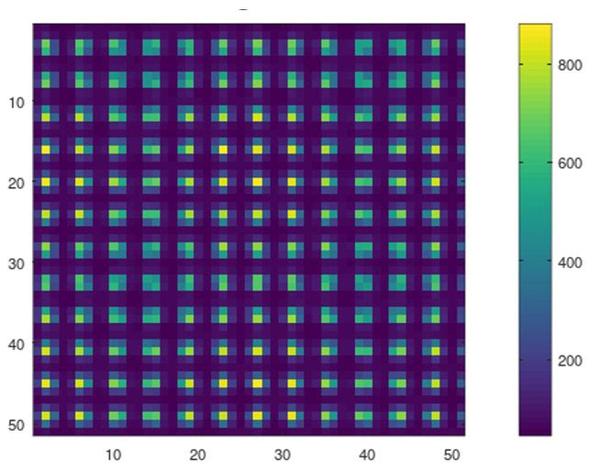
optimized stepped-kernel MWA (Moving Window Average) filter provides a practical, mathematically sound solution to aliasing and averaging challenges at low sampling ratios. It ensures precise suppression of display pixel matrix modulations, reducing the need for oversampling and improving both cost efficiency and measurement reliability in display characterization.
References
[1] Schanz, R., Fischer, F. and Steinel, T. (2024), 58-3: Impact of Calibration
Sources on Accuracy of Chromaticity Measurements of LED based Displays. SID Symposium Digest of Technical Papers, 55: 801-804. https://doi.org/10.1002/sdtp.17649
[2] Steinel, T. and Wolf, M. (2021), 58-3: Invited Paper: Color Uniformity of μLED Displays: New Color Calibration Concept for Fast
and Accurate Optical Testing. SID Symposium Digest of Technical Papers, 52: 822-825. https://doi.org/10.1002/sdtp.14809
[3] Tobias Steinel, Habib Gahbiche, Pooja Baisoya, Roland Schanz, (2023), Invited Paper: Rapid Testing of µLEDs and Microdisplays on Wafer. ICDT China, Session 24.3.
[4]
Becker, M.E. and Steinel, T. (2025), 30-3: Matched Moving-Window Averaging Filter. SID Symposium Digest of Technical Papers, 56: 397-400. https://doi.org/10.1002/sdtp.18176