Authors:
[1] Dr. Kedar Sathaye, Product Manager Light & Display at Konica Minolta
Sensing Europe B.V.
[2] Dr. Valentyn Volkov, co-founder of XPANCEO
The market for image display devices is rapidly evolving, with innovations ranging from advanced screen technologies in smartphones and TVs to more sophisticated solutions like augmented reality (AR) glasses and virtual reality (VR) headsets, such as the Apple Vision Pro. The XR market alone is projected to reach an impressive $1,913.7 billion by 2032, with a growth rate of 39.2% from 2024 to 2032. There’s an increasing focus on making these devices more wearable and user-friendly.
Achieving this goal, however, presents significant challenges due to the limitations of current technologies.
Wearable devices, particularly in the AR and VR sectors, often face critical performance issues. For example, AR glasses and VR headsets frequently lack sufficient brightness, have limited battery life, and often end up being bulky due to the need for larger batteries. These issues
can lead to overheating and reduced field of view, decreasing the practicality of these devices for long-term use. This is driving the industry to innovate and develop new devices that overcome these challenges. However, this rapid development invites another problem: the lack of comprehensive test solutions to ensure that these new devices meet the required standards for quality, safety, and performance.
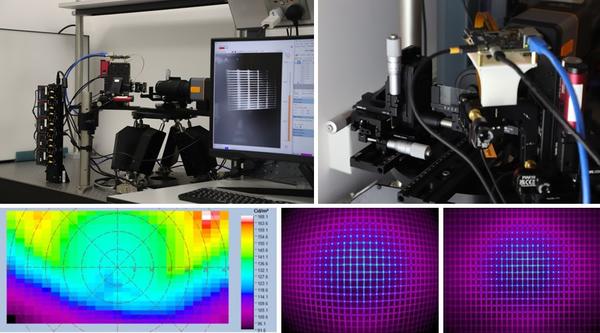
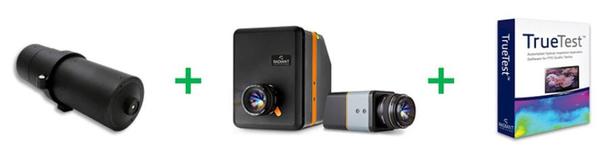
In response to this gap, Konica Minolta and XPANCEO have partnered to meet the growing demand for contemporary test solutions.
AR Smart Contact Lenses
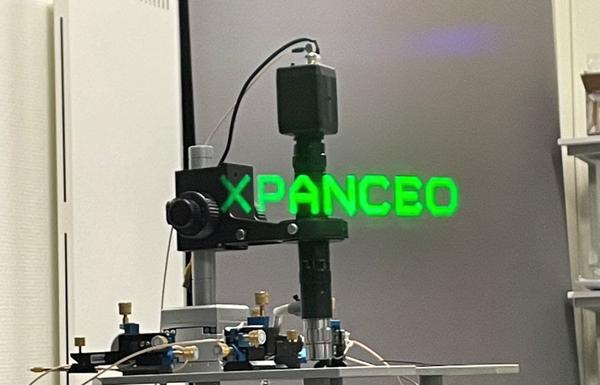
XPANCEO is a deep-tech company pioneering smart contact lenses, a new frontier in wearable technology that it envisions as the next generation of computing. These lenses aim to solve the problems of current wearable technology by integrating various traditional device functions into a single interface that is weightless and as natural to the wearer as their own vision. Beyond
applications such as health monitoring and enhanced vision, a key focus for XPANCEO is image projection. The company has already succeeded in developing a smart contact lens with a display that significantly outperforms standard solutions. By reducing the resolution in the peripheral vision area—where the eye does not require high
resolution—the load on the video controller is minimized, allowing for much smaller packaging. Additionally, the brightness loss from the display to the eye is reduced threefold, and the total power consumption is expected to be only 1-3 µW, which is 100-300 times less than comparable AR glasses. However, this technological advancement
raises new questions about testing and quality assurance, as there are currently no ready-to-go solutions on the market. |
| |