MicroLED-Info weekly newsletter
Published: Tue, 09/27/22


The MicroLED-Info newsletter (September 27, 2022)
Cannot read this? View it online here
Spotlight on Radiant Vision Systems: a Microled Industry Association member
Today we're starting a new series, of interviews with MicroLED Industry Association members. The first company we interview is Radiant Vision Systems, and we have Shaina Warner, Radiant''s Marketing Program Manager.
Q: Can you introduce your company and technology?
Radiant develops and manufactures test & measurement solutions that are used to evaluate the visual quality of displays, backlit components, LEDs, other light sources. Using photometric and colorimetric imagers calibrated to a model of human visual perception, Radiant offers the most sophisticated inspection technology for ensuring light-emitting products meet customer expectations for quality and performance.
Leaders in consumer electronics, virtual & augmented reality, automotive, aerospace manufacturing, and beyond rely on Radiant to ensure accuracy, automate quality control, reduce costs, and improve efficiency. We have over 30 years of proven production experience with thousands of cameras testing millions of lights and displays worldwide. We’re also happy to be a global organization, offering direct local access to products and support that help equip our customers for success.
Q: Can you say why you joined the microLED association and what it is you hope to achieve?
MicroLED and QDs: Selected Technology Highlights by TechBlick
This is an article by TechBlick, organizers of the upcoming MicroLED Displays virtual event. MicroLED-Info readers get a 100 Euro discount.
In this article, using select technology slides, we highlight several interesting advancements in MicroLED and/or QD displays. More specifically, we cover 3600PPI “Silicon” Displays | Gravure printed microbumps | Electrohydrodynamically printed QD color converters | Laser LLO and Transfer for MicroLEDs | QD vs Phosphors | Energy saving credentials of microLED
“Silicon” Displays with an incredible 3600ppi full color using microLED and QD technology?
Sharp (HIRANO Yasuakie et al) has developed this technology.
As shown in the slide below, first blue-only uLEDs are formed on a sapphire substrate. Here, one LED array contains 352 x 198 micro LED dies of 24 um x 8 um in size. In parallel, an LSI chip containing the driving circuitry is formed on a silicon wafer. Here, the cathode (N-type electrode) and anode (P-type electrode) are fabricated for each micro LED die to apply driving voltage independently to each die. The Au bump electrodes are fabricated in accordance with the pitch of the LED dies. The two substrates are flip-chip bonded using Au-Au bonding. Here one can already see the parallel to the silicon and optoelectronic industry (vs. the traditional thin film display industry!). Next, the sapphire layer is removed via laser lift off. Finally, Cd-free quantum dots (green and red) are deposited atop the microLED dies to enable R G color conversion. This way one achieves RGB colors
The device architecture is shown in slide 2- here one can see the location of GaN uLED dies, Au bumps, as well as light shielding walls and quantum dots (QDs). This way, a full color 1,053 ppi display is formed.
However, given the small size of the emissive area of uLEDs, the brightness is low. An innovative solution here is to switch from individual driving cathode electrodes to a common one, thus freeing up more spaces for uLEDs. As shown in slide three, the light emission in one pixel was improved from 23% to 38%. As a result, brightness of 11 knits was achieved. This is an excellent progress. Of course, it is not the final game as even at 11 knits the brightness is not yet not sufficient for outdoor AR applications.
Join us and your industry peers on 30 NOV – 1 DEC 2022 at our first-ever specialist microLED and QD event to hear more about this technology from Yasuakie-san et al.
Gravure Printed Microbumps for MicroLEDs
As microLEDs inevitably shrink in size, the micro-bumping requirements for the microLED dies becomes more challenging. Direct wafer-based printing based on gravure offset techniques offers a promising solution in this regard. Indeed, this is another field where printed electronics can play a role.
Komori has recently achieved excellent results, which will be unveiled at TechBlick's upcoming microLED event on 30 Nov-1 Dec 2022.
As seen in the slides below, gravure printing can print microbumps printed using flux paste, achieving a printing precision of 5 µm within a range of 300 mm. The first slides show the precision of the printing position on a wafer. In particular, it compares it with screen printing, showing how gravure printing advances the fine feature printing capability w.r.t screen printing (+/-10 um although screen printing too can and will also advance)
As shown in slide two, the minimum diameter that can be printed with SAC (Sn, Ag, Cu) solder paste is 6 μm and the distance between the centers of the bumps is 30 μm. Reflow has been successful with a minimum diameter of 10 µm. This way for example, a microLED die in the size of 30um by 50 or 80um can be supported.
Furthermore, as shown in slide three, this technique also offers the possibility to control the thickness by printing several diameters. The smaller the bump diameter, the higher the aspect ratio.
These are very nice results, showing the viability of gravure printing technique for microbumps. This technology can support current and near-term generations of microLEDs but will it evolve as microLED dies further shrink in the longer term?
High-PPI RGB microLEDs, printed electronics, and quantum dots?
The three themes are closely linked since QDs can be digitally printed as color conversation materials atop blue microLEDs to enable wide color gamut RGB uLED displays without requiring a separate transfer step for each color.
Inkjet is the common technology investigated for such a purpose. As shown below by Prof.Armin Wedel, however, its 4pL droplet is too large, allowing at best a 40um pixel and not able to reach even 850 dpi
Electrohydrodynamic printing (EHD) can however address this issue. In EHD, the droplets are pulled out by an electric field from a nozzle which sits close (50um or so) to the surface and thus requires a good printing facility.
As shown below, the droplet volume is only 0.5pL, enabling 1-10um pixels in the lab and 15um reproducibility. This will enable one to achieve 850ppi and 1000ppi!
Slide 2 shows an example of a QD color filter (QD-CF) for a microLED display deposited using EHDJet. Here, 15um pitch is reported, achieving 1000ppi. The roadmap will be to evolve the technology towards even 2000ppi!
These are excellent advancements of the art and technology, paving the way for the development of high-PPI microLED technology
Of course, EHDJet is a relatively new technology. It is mainly single head and slow, although multi-head print heads are emerging. Nonetheless, it is an elegant solution for depositing color filters on high-PPI microLED displays.
To learn the latest about these technologies join TechBlick's specialist event on microLEDs and Quantum Dots where Prof. Wedel will also present.
Stable RoHS-compliant Cd-free QDs for microLEDs?
This technology is required to simplify the manufacturing of microLEDs- this way one need not transfer R G B uLEDs but can only transfer the already efficient blue uLEDs and achieve RGB color via red and green QD color conversation.
There are of course multiple material challenges including achieving Cd-free green and red QDs with (1) high enough thermal and light stability for direct integration into microLED chips, (2) high blue absorbance even at low thicknesses to prevent blue color leakage, (3)narrow FWHM and high QY, (4) low self excitation, etc
QustomDot -spin off from Zeger Hens group at Ghent University- is making excellent progress in this field. They have a novel high-controlled synthesis process for InP based QDs. Last year, at TechBlick they shared some interesting stability data for QD integration in macro and thin film LEDs. These results are shown in the slides below. They show a clear pathway towards development of QDs for direct on-uLED integration
The 500um thick QD level integrated on a macro LED shows >>300hours stability even under 1W/cm2, and a 100-150um QD thin film under 130mW/cm2 also shows >>1500 hours photostability in insert conditions
These are results from last year. To hear the latest developments from QustomDot on QD-on-microLED please join TechBlick's microLED and QD event. Check the world-class agenda here.
How are micro-, mini-, and traditional LEDs defined?
Eric Virey - super analyst in the field Yole Group - prepared the below chart, showing the key differences between each.
Traditional LEDs come in SMD or through-hole packages and the dies are typically 1mm or larger. This well-established application finds use in general lighting, automotive lighting, and LCD backlights.
Min-LEDs are typically smaller than 200um in die size but larger than 50um, and come in SMD or CoB (chip-on-board) packages. They are currently commercial and find applications in LCD and keyboard backlights, narrow-pixel pitch LED direct view LEDs, and other sectors. In the LCD sector, they are suited to provide local dimming to improve contrast, making LCDs more like OLEDs on this feature.
A new version of our MicroLED Transfer Process Market Report released
Today we published a new edition of our MicroLED Transfer Process Market Report, with all the latest information. The new edition includes news from related companies, new in-depth details on two transfer processes and more.
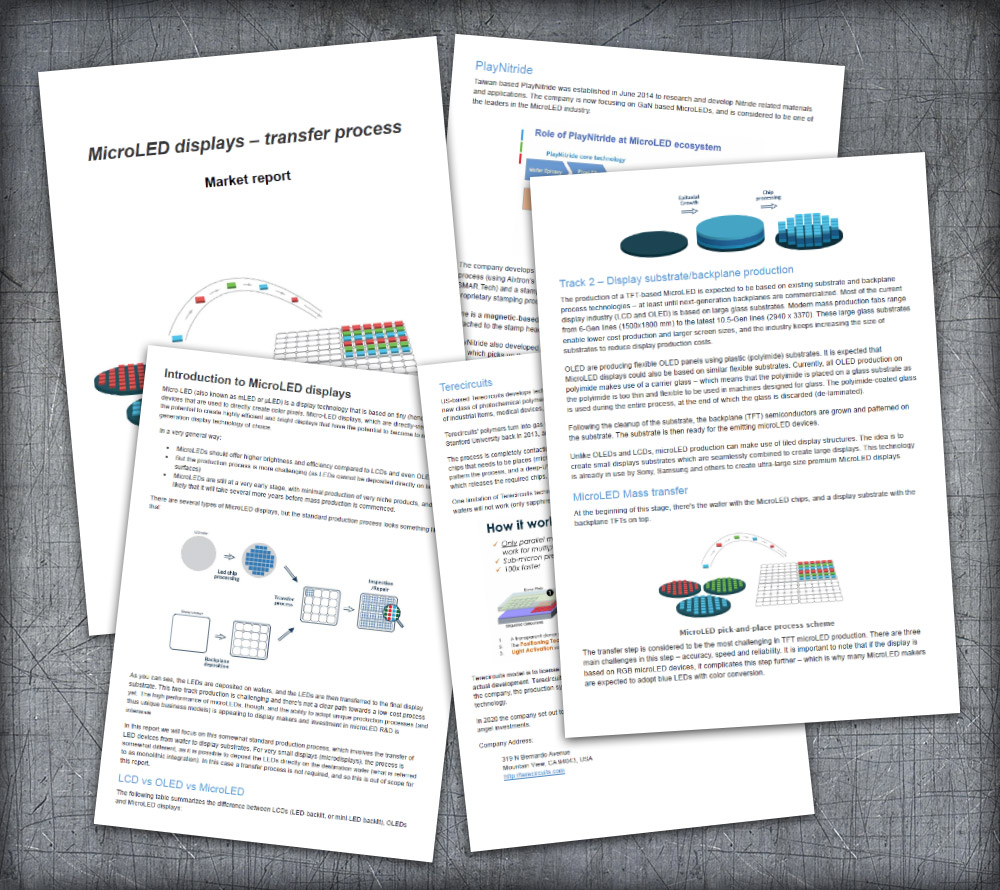
Reading this report, you'll learn all about:
- All known microLED transfer processes
- The current industry and market status
- Advantages and disadvantages of transfer technologies
- Future technologies and roadmaps
The report package also provides:
- An introduction to microLED production processes
- Over 20 presentations, brochures and technical papers
- MicroLED chip-level market estimates and forecasts
- Free updates for a year
This microLED display transfer process report provides a comprehensive look into current and future LED transfer technologies processes used for the production of microLED displays. The report covers everything you need to know about the current status of the industry.
PlayNitride is working with customers on automotive microLED displays, expects first concept car demonstrations in 2024
Digitimes reports that PlayNitride is starting to sample microLED panels for 5 or 6 potential automotive customers. The customers are interested in flexible and transparent panels, and they have engaged PlayNitride in custom R&D projects to develop the required displays.
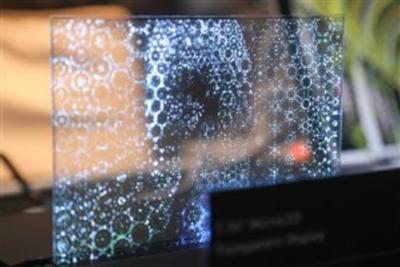
PlayNitride's CEO, Charles Li, noted that the company expects its customers to launch several concept car models in early 2024, equipped with the new microLED displays.




Metalgrass LTD
9 Har Tsin St.
Kfar Sava Hasharon 4430809
ISRAEL
Unsubscribe | Change Subscriber Options